

The Cave and the Machine
What Chauvet’s rock paintings and Pāṇini’s chanted grammar say about handing over thought, work and action to AI.

Grüezi!
A little venture into human pre-history, and human future.
1. Chauvet
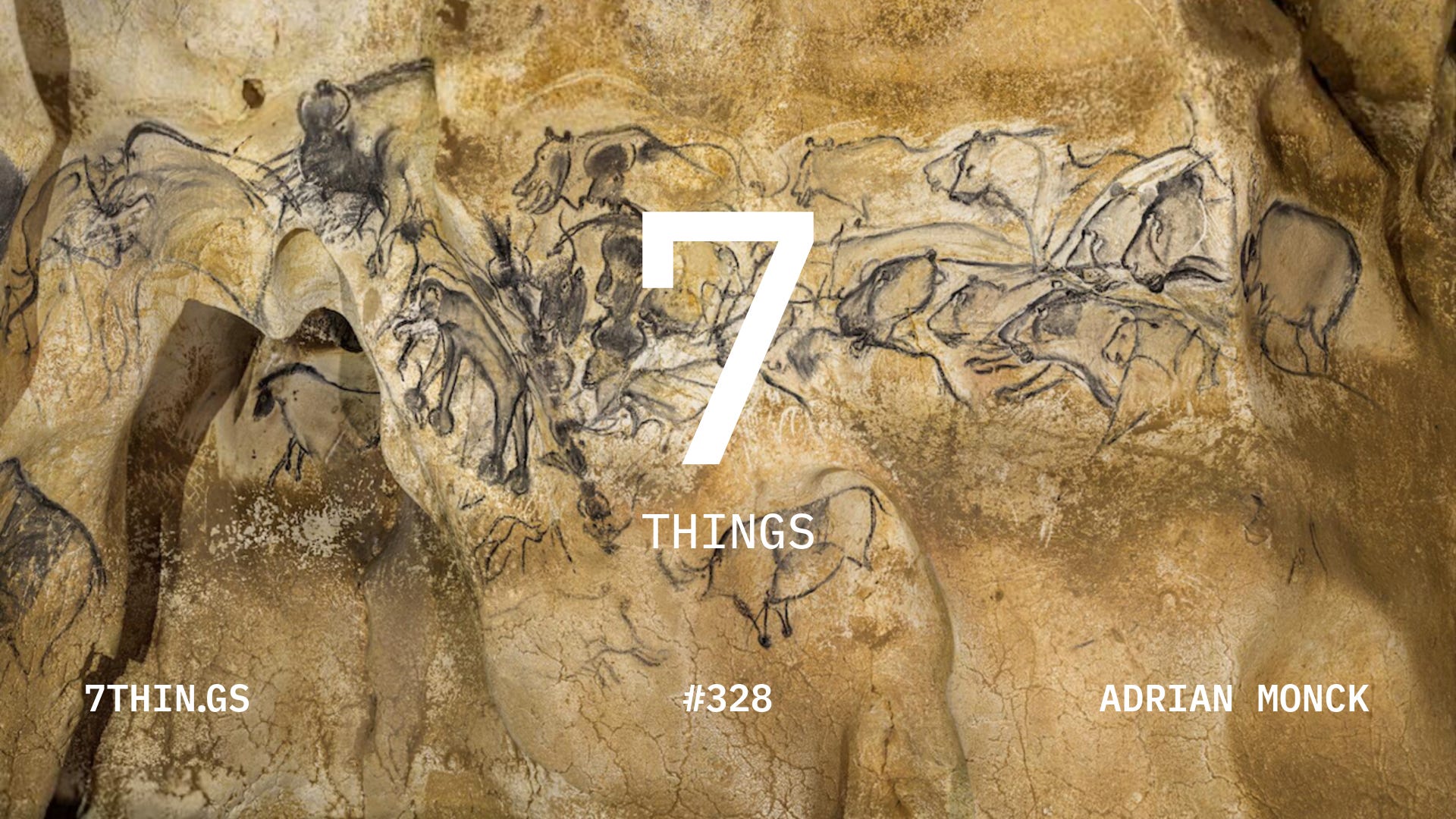
You can’t visit Chauvet. The cave – and the paintings within, which were made over 35,000 years ago – has never opened to visitors since it was first discovered in 1994. A few kilometres away there’s a replica, opened in 2015, that reproduces the pictures, the darkness and the damp. But for the rest of us, the cave’s art exists only in photographs. And the photos make the paintings flat. We see everything at once – every lion, every horse, every rhinoceros, every crease in the rock – under a dull, even light.
We don’t know how the painters and those who accompanied them saw these walls precisely, but we do know they found their way through deep passageways, probably by torchlight, and that the flame would have shown the animals only partially, one appearing as another fell back into the darkness. Chauvet’s remarkable images are the starting point for T.J. Clark’s essay ‘Night Visitors’ in the London Review of Books. Clark asks what depiction was at the very beginning, and his essay set me thinking about what we call progress and the trade-offs it involves.
I can’t draw anything like as well as the Chauvet artists, and nor can I hunt like them, but I can read. A lot of things in the intervening millennia have been lost, but also gained.
Clark argues that painting does things that speaking can’t. Language runs in order. This follows that. This sits inside that. This word means that. A picture is different. It can hold several things in tension at once. Figures and fields can keep redefining one another, and nothing has to be resolved for it to register. Somehow the eye and the imagination conspire to make sense of it all.
He treats this as a kind of rivalry between two ways of knowing. We can’t prove Clark’s account, and images themselves can impose order just as much as words can hold ambiguity, but the theory brings Chauvet’s walls back to life.
My own favourite cave paintings are at Rouffignac, deep in the dripping rock of the Dordogne, where you ride a little electric train almost a kilometre underground to reach the mammoths. Rouffignac’s about 13,000 years old. Chauvet is more than 20,000 years older. More time separates those two caves than separates Rouffignac and its mammoths from us.
So much that is lost to the present was also lost to them. We still have brilliant artists today and we have bowmakers and we have hunters, but what Chauvet holds is something that no expert can recreate. The world those animals and their painters belonged to has gone, and with it, Clark says, a distinctive human way of seeing the world and being in it.
And that’s what makes the caves so powerful. A society can gather strength whilst the way of seeing quietly disappears. And once you recognise that, progress no longer quite seems like more, and no longer quite seems like better.
2. The mind outside
We didn’t succeed as a species by keeping everything inside our heads. We made thought shareable in speech. We put memory into marks and glyphs and numbers. We wrote rules into laws and institutions. We moved force and power into mills and engines, and sums into the abacus and the chip. Each move made the system more capable and more complex and more inscrutable.
But the gains are pretty enormous. No one has to rediscover geometry or penicillin, or reinvent double-entry bookkeeping, or construct an electrical grid from scratch. Knowledge outlives the knower. Strangers can coordinate with one another across continents, and a specialist can devote a career to one specific problem, happy in the knowledge that other specialists are keeping the rest of life ticking over.
This isn’t a fall from some earlier state of graceful self-sufficiency. The people who painted Chauvet already relied on one another, on inherited techniques, on pigments and tools that others have discovered, and stories their own ancestors had probably told, and they relied, of course, on the cave itself.
Pace Descartes, we have always thought best with other people and with things. Prometheus may have stolen for us the sacred flame of the gods, but we still have fire insurance.
Still, everything we put outside our minds shifts the balance between what we can achieve collectively with it and what we as individuals still understand without it. And through prehistory and history, we’ve always lost things that way, and that loss has cost us.
3. Win some, lose some
We’ve had writing for millennia, but mass literacy for little over a century.
For the individual, reading and writing has brought escapism, social and civic connection, knowledge, membership of a group that shares a common language, and new kinds of expertise. But set against that is broad manipulation, propaganda, new types of control.
For the collective, there’s the benefit of lasting memory, coordination, invention and scale. But against that, power is concentrated into fragile systems, monocultures spread, and knowledge built beyond what any individual or group can maintain becomes precarious.
In the beginning came the split. Group capacity rose – surplus, storage, cities, everything that we call civilisation. But individuals shrank, and not just metaphorically. Skeletal remains show people shorter, sicker. They traded nomadism and the relaxed, occasionally exciting world of the hunt for sedentary drudgery. Hunting, by the way, remained a favoured pursuit of elites throughout human history.
They began relying on a few staple crops instead of the rich variety of a foraged, seasonal diet. One survey found that health declined in 19 of 21 societies that made that change. The surplus and the cities left the ruins and the relics we admire, but the bodies left only their bones.
The social gains of complexity and the loss of embodied function aren’t evenly distributed. Agriculture allowed some people to become temple scribes and even prophets and kings. But it allowed many more to become field labourers and slaves. People proliferated at the new threshold, but few prospered.
And the fear that we lose something by putting it outside ourselves is also very old. In Plato’s Phaedrus, Thamus warns that writing will breed forgetfulness and hand people the appearance of knowledge without the substance. Writing made laws that outlasted rulers and created empirical knowledge that could be checked across generations.
But writing wasn’t the only way to hold a complex system in mind. Pāṇini’s grammar of Sanskrit runs to some 4,000 rules, and it was committed to memory for centuries before anyone wrote it down. Its terse, chant-like form was itself a kind of technology, built so the whole system could be held in real minds and passed down to other people. It was embodied complexity. But bodies contained it.
4. The new threshold
Until now, the things we handed off were the raw materials of thought and its residues. Applying it was still a job for humans: knowing what to reach for, reading the situation in front of you, framing a problem and settling on a measure, judging whether the answer was actually any good.
Now a system can take a request, work out what it means, choose the steps, carry them out, look at the results and try again. What Kafka’s imagined bureaucrats did blithely and blindly, Jensen Huang’s very real chips can now do with almost equal disregard.
Now we have alienated action, and it will bring great benefits. Robots can work with greater precision, endlessly. Machines can solve mathematical problems. But can we keep pace? When a recent puzzle was solved, one maths professor lamented online that we would have run out of mathematicians to check computers’ work.
5. The apprentice
Expertise has long been built in humans through repeated trial and error, correction, and the slow widening of responsibility. You can’t get it by being handed the conclusions of other experts. This is why junior tasks aren’t what they seem.
A young teenager in the workshop of a Florentine painter, would grind pigments, prepare panels, and – if lucky – get to fill in some background on a great work. Michelangelo began his career in art in the workshop of Ghirlandaio. (In case you wondered who he was - he did the walls of the Sistine Chapel, the apprentice did the ceiling.)
Things that today look expendable from the very highest corporate floors may be the apprenticeship from below. Take out the routine first-year work, and a firm may improve this year’s numbers, whilst quietly cutting off the supply of people it will need in a decade’s time.
And the first job is more than training. It’s where someone gets colleagues, rivals, recognition, purpose, a professional identity. Remove the work that used to do all of that, and the loss isn’t just a task or a skill.
6. Who owns the mind outside?
Adam Smith saw the human cost of industrialisation coming, writing as the first mills and manufactories were being established. He opens The Wealth of Nations by deconstructing the process of pin-making to explain the division of labour. But by Book Five, Smith asks what reducing life to one or two monotonous chores does to a human being. Such work, he says, makes a person ‘as stupid and ignorant as it is possible for a human creature to become’.
In the twentieth century, Harry Braverman, a self-taught Marxist firebrand who spent years as a metal worker, gave Smith’s process a name: deskilling. Management takes the planning of work and leaves workers with a narrower and narrower slice of the process. Machines weren’t the point, though. It was the fragmentation of the bargaining power of skilled workers and the power structure embedded within it.
It’s happened to many occupations already. Computers began as people. Computing, or calculating, was, in the last century, a job done mostly by women at observatories and ballistics ranges. Because women did it, it tended to be poorly paid and lacking in prestige. When the machines came along, they were given the name and the work that went with it. And computers, naturally, decided none of that.
AI can drive the same movement through office work, through planning, researching, drafting and judgement, all being drawn into a system owned by an employer or a platform. But it won’t be AI that decides the social value that accrues to ownership or each person’s place in whatever order comes to pass.
7. The hands on the controls
Unfortunately, we rarely get to choose what we hang on to. Mostly it gets decided for us. The way of seeing that Clark describes at Chauvet disappeared because its world disappeared. Smith’s worker loses the wider capacity to engage in society because the work narrows tasks and minds. The capacity disappears when what required it disappears. By the time anyone can think to defend it, there’s no one left to remember it.
The cave is at the long tail of this human story. Venturing into the cosmos is at the other. The first Mercury capsule to carry a passenger put a chimpanzee into space and brought him back. It was a straightforward ballistics exercise. The trajectory was fixed from launch. The American men chosen to follow the chimp into space were test pilots, and they refused to be, in a memorable phrase, ‘spam in a can’. They pushed the NASA engineers for a window, an escape hatch that they could detonate themselves, and a joystick to guide the capsule. None of it was mission critical, but they got it because the public programme during the Cold War needed heroes, and heroes, it seemed, needed agency.
The Soviets had built much the same machinery, but they kept their crew as passengers. They had heroes too. Yuri Gagarin was briefly the most famous man alive. Communism could cope with celebrities, but it didn’t require its officials to pander to them. Soviet cosmonauts were chosen to fit their cramped capsules, right down to their height. Early Soyuz missions flew themselves, and when the automatic systems failed, missions were scrubbed. The difference wasn’t rocket science – it was power.
I wrote earlier that knowledge outlives the knower. That isn’t true. Records outlive knowers. Knowledge doesn’t. Writing didn’t free knowledge from mortality; it freed text from mortality, and text only becomes knowledge again when a human being picks it up. That’s why the Renaissance gets its name. It is a rebirth, literally, of knowledge that had been lost for centuries. Pāṇini’s grammar lasted centuries because an institution kept putting it into new bodies, one generation at a time.
A society is also a disembodied repository. It doesn’t have a skull, but it remembers in writing. It records by counting. It decides in its courtrooms and marketplaces.
It is a function networked across concatenated human beings. We are the nodes, and like the systems we’ve lately built, it’s opaque to its own parts, and we continually struggle to understand them. Bureaucracy was not the precursor to today’s machines, but it was in a sense their first draft.
But this networked functionality has no persistence of its own. It doesn’t survive – unlike the images. It’s not a thing that endures. It’s a thing that’s continuously re-enacted in people, and when that re-enactment stops, it doesn’t decay like a building; it just ends like a conversation.
What persists are only material traces. Chauvet’s paintings are proof both of their fidelity and their uselessness. More than thirty-five millennia of perfect preservation, and nothing of the networked capacity that animated their creation.
Human nodes are erased in decades. Networked functions can die in a generation unless they’re re-enacted. The Christianity of Rome survived. The paganism is entirely gone. Only the artefacts persist, inert and mute. The temple pillars, the statues of gods. The node bears the cost, the function registers the outputs, but the artefact bears witness to neither.
And here’s the cold hard fact that underlies the whole argument: mortality isn’t the constraint. It’s the engine of the network’s function. The node’s finite span is what makes schooling necessary, and schooling is what makes the function real.
If that function ever migrates – nodes that form networks amongst one another, slowly, and keep their own records – how would we know? Not in the way that Chauvet was discovered. There’ll be no rockfall to push aside, no millennia of quiet, and then a stranger’s torch.
The cave is being dug inside our own infrastructure.
The early signs will be misread in both directions. The machines trained on our accreted data will hold practices that are both parasitic on ours and familiar to us. We’ll see our faces in the noise.
But Chauvet’s preserving rockfall is the wrong emblem for what comes next. It was pure luck, the finale of a group of humans preserved by accident. Nothing in our present drift is luck, and there’ll be no sealing up or burial or rediscovery, no long darkness in which the preservation is perfect and the loss complete.
Anything human, we must remind ourselves, is kept by being re-enacted and repeated. And we are the sums of our redundant rituals being optimised out of our machines.
Thanks for reading!
Bis bald,
Adrian