

China’s Deflation Machine
Credit where it isn’t due. Why more lending in China means lower prices.

Grüezi!
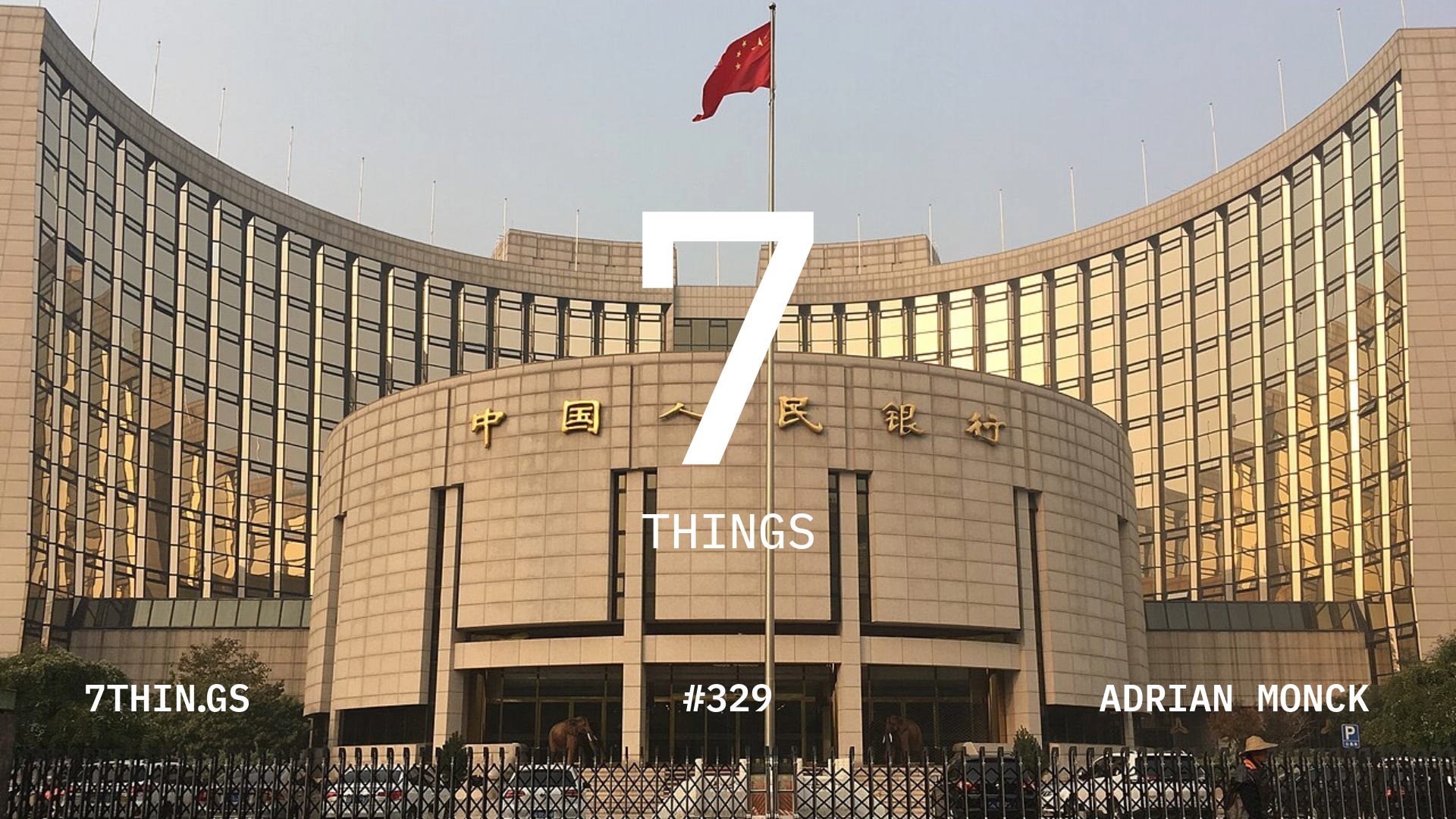
Every time China’s economy slows, the People’s Bank of China floods the system with credit.
Anywhere else, and that should mean inflation. But China doesn’t work on those rules.
This is part of a five-part series built around a single question – when a system under this much strain can’t crack from within, where does it break instead?
1. Money for nothing
Since 2007, China has run repeated waves of monetary expansion – in 2009, in 2013–15, in 2020, and again through 2022–24.
The economics textbooks say that sustained credit growth should, after a while, lift demand and trigger inflation.
Not in China. The more that Beijing has eased, the cheaper things have become.
It took the oil shock from the Iran conflict, which ramped up domestic energy costs, to halt a three year slide in producer prices.
2. Demand today, glut tomorrow
A new NBER paper by Jeffery Chang of the Chinese University of Hong Kong, Shenzhen, and Wei Xiong of Princeton offers a very straightforward explanation.
In China, cheap credit flows to firms rather than shoppers, because the banking system is built to finance production.
A firm spending a loan is a mini burst of demand: it buys things, hires workers, pays suppliers, and for about a year all that spending buoys prices, exactly as economics textbooks predict.
But what the loan ultimately pays for is more production – extra shifts, new lines, another factory – and that production shows up as supply.
Once it comes on stream, those products hit a market where household spending is essentially dormant, and the only way to shift them is to slash prices.
3. Fingerprints everywhere
Chang and Xiong tracked what happens to inflation when loans grow month by month, using data from 2007 to mid-2025. They found a pretty regular pattern.
When loan growth picks up by one percentage point, producer price inflation rises by about 1.8 points after a year. Then the effect fades, and after about a year and a half it turns negative – knocking roughly a point off inflation just short of the two-year mark.
Consumer prices follow suit – up about half a point at the one-year mark, then falling back.
This is a curious result by international standards. In the United States and most other economies, easier credit also raises output, but then it leads to inflation, because demand rises along with supply. It might take a while, but prices don’t rise and then slump back again.
Something about China is different.
Using balance-sheet data from listed industrial firms, the authors track what happens when an industry’s borrowing picks up.
Faster debt growth predicts lower producer prices within three quarters: debt subsidises overproduction, and the excess has to find buyers.
But even at lower prices, not all of it does. Inventory turnover – the rate at which stock leaves the warehouse – slows by around 1.3 points a year later and unsold goods start piling up.
And profits take a hit. With prices falling and stock sitting in storage, a one-point rise in an industry’s debt growth leads to a 0.43-point fall in operating profit growth a year later.
Leverage, meanwhile, rises and never unwinds. Once an industry starts borrowing, it never stops. There is an institutional reason for that, which we will take up later in the series: in a system where the banks are state-owned and the biggest borrowers are state-linked, nobody ever has to pay down their debt.
At the national level, the borrowing shows up as plant going idle: capacity utilisation – how much of China’s industrial machine is actually running – drops by 0.39 points one year on from each point of extra credit growth.
The authors are careful to distinguish cause from effect, since Beijing eases when the economy slows down and the arrow could run either way, but the same things show up everywhere.
Put all the pieces together and you can see how China’s credit machine works. Loans are pushed to firms. Firms use them to keep on producing, whether or not there are buyers. Output outstrips demand, warehouses fill up, prices fall and margins get squeezed.
And the response to falling margins? Another round of credit, because the alternative is to let firms fail.
4. Follow the money
The smoking gun is right there on the balance sheet of the People’s Bank of China – it’s called structural relending.
At the end of 2024, structural relending was the PBoC’s biggest domestic lending programme, handing over 6.3 trillion renminbi of central-bank money to banks on the condition that they lend it on to the sectors Beijing chooses.
That’s bigger than both the Medium-term Lending Facility (the PBoC’s standard no-strings-attached channel for lending to banks, 5.1 trillion), and ordinary open-market operations (day-to-day plumbing for the money supply, 3.4 trillion).
What started as a policy experiment is now the single biggest channel through which China’s central bank injects money into the economy.
Whilst western central banks mostly steer the volume of credit, the PBoC picks the direction too, and that is pointed straight at production.
5. Hunger Games with Chinese characteristics
Xiong calls this “Mandarin Capitalism”.
China has real markets, with real competition and real winners and losers, but on top of all this is the state. And the state treats finance as a means of directing investment and hitting its own centrally-directed growth targets.
The competition this produces is a kind of Hunger Games.
The state builds the arena and chooses which sectors enter it; hundreds of firms and cities then fight for survival, and the rare champions that emerge, a BYD or a Huawei, come out tough enough to take on the world.
There are two Chinese twists. The losers are never really allowed to die: local governments prop them up, and state banks roll over their debts.
And they get to set their own victory conditions.
6. A race to the bottom line
Within that system, monetary policy has a job description that would be unrecognisable in Frankfurt or Washington.
It functions as a sticking plaster for balance sheets.
That sticking plaster keeps the borrowing arms of local governments afloat, ensures that state-backed borrowers continue to pay their debts and, most notably or nastily for the rest of the world’s manufacturers, helps industrial capacity tick over through downturns.
The machine props up loss-making industries through the hard times, or subsidises overcapacity to be dumped at a loss overseas. It all depends where you’re sitting.
And critics aren’t slow to call foul. Nearly 30 per cent of Chinese industrial firms are unprofitable, up from 20 per cent before the pandemic, and that reaches over a third – 34 per cent – in the sectors prioritised under Made in China 2025.
According to The Economist, a bigger share of Chinese industrial firms is making losses today – around 32 per cent as of April – than during the 1998 Asian financial crisis.
The throat-cutting competition that results, with firms grinding each other down to razor-thin margins, has a now familiar name neijuan, or involution.
Firms use their loans to produce more to sell even at a loss, subsidised by local governments whose own revenues depend on those businesses staying open.
It’s not cheap. Last year, economists at the IMF estimated that over the past decade the policy has cost China about 2 per cent of GDP annually – $400bn down the drain every year.
7. The missing customer
Yet most economists would argue that this should all come out in the wash.
Even if credit is pumped into firms, it morphs into wages and payments to suppliers, which then turn into household income, which then turns into spending. In conventional terms, the initial borrower shouldn’t really matter.
But in China, household income is where conventional economics breaks down.
As Chang and Xiong point out, the household income gains go mainly to employees who are grimly staring down a property slump, an ageing society and a precarious job market. No one is hitting the town with their extra cash.
The evidence backs it up. When China’s credit eased from 2019–24, the country’s households did not engage in a lottery-winner-style spending spree. Instead, they prudently paid down their mortgages. Given the choice, they’d rather drop than shop.
So the circle continues. Credit sustains production; production outruns demand; prices fall; falling prices mean more credit.
Each turn of the wheel leaves the industrial sector bigger, more leveraged and less profitable than the one before, and that is the engine of China’s deflation, and of the export flood that the rest of the world is now arguing about.
Which raises an obvious question. If the problem is China’s households, the direct fix would be to put money into their pockets instead. Or at least to give them some of the welfare support that might make them a little less inclined to save for a rainy day.
Chinese economists have argued for exactly that for years, and the IMF has even costed up a version of it.
In July, China’s Politburo met to set economic policy for the second half of 2026. Retail sales were growing at barely one per cent.
What that meeting decided, and what the decision reveals about whose interests the system is built to serve, is the subject of the next newsletter.
Coming up – ‘The Choice’: why China’s leadership has decided its households can wait.
Thanks for reading!
Bis bald,
Adrian