Capitalism’s Quriltai
Davos meets to confirm a new khan. The world may not oblige.
Grüezi!
I’ll be heading up the mountain next week, so posting may be limited. Here’s my take on what it all means this year.
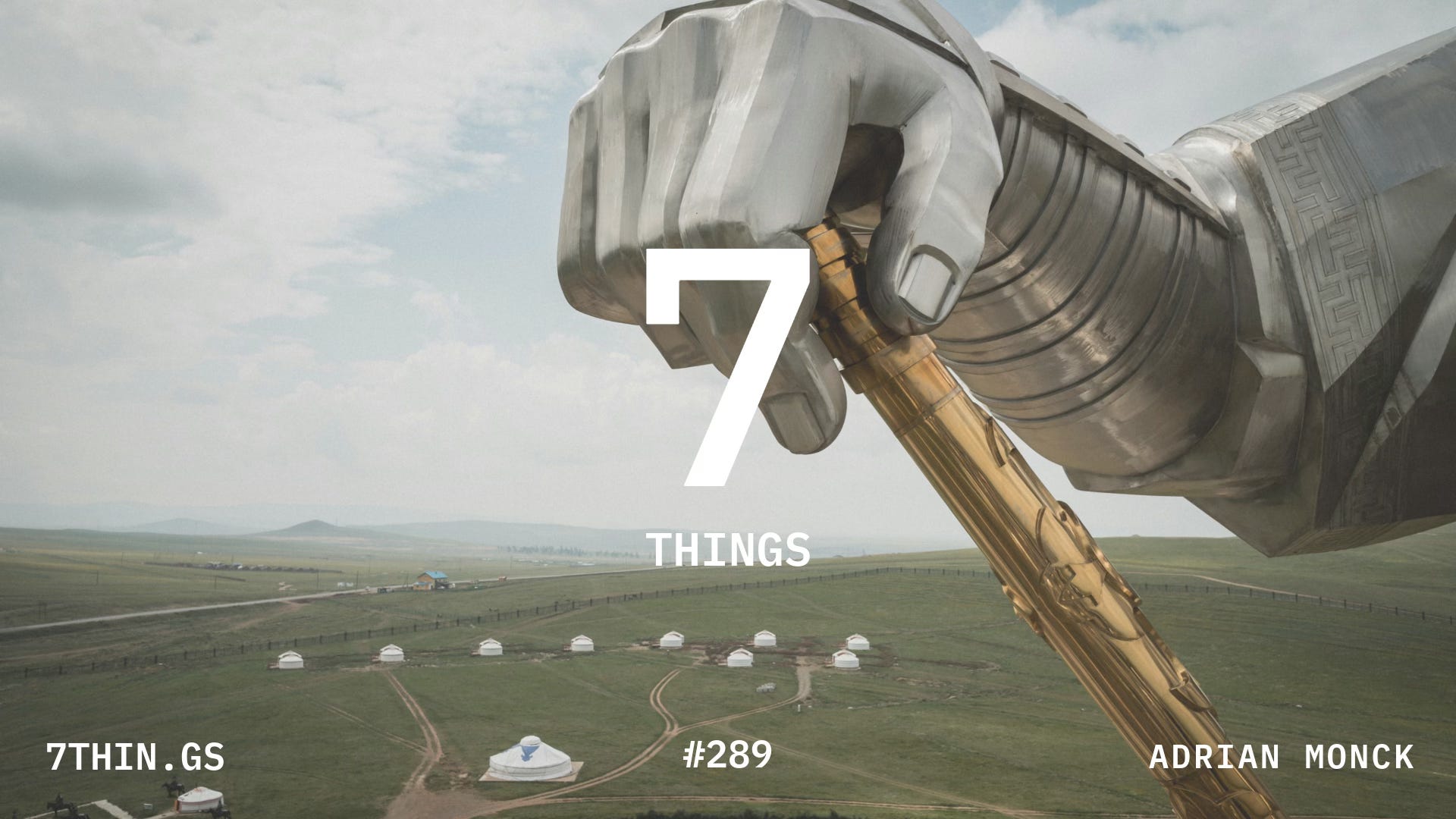
It is nearly 800 years since Genghis Khan died. His empire held together through his personal authority and the network of loyalties he had constructed through decades of cut-throat conflict, cunning, and connivance.
The Mongol solution to this succession crisis was the quriltai – an assembly of nobles and commanders who would gather to confirm a new khan.
It was not a coronation. It was a negotiation among powerful chiefs who could defect or rebel if dissatisfied.
The successful candidate needed to demonstrate capacity, political skill, and sufficient generosity to reward followers.
Above all, they needed to build coalitions among factions with their own interests and their own claims to legitimacy.
Authority on the steppe was dynamic and emergent – leaders rose through demonstrated capacity, assembled followers through success, and fell when they failed to deliver.
Capitalism’s quriltai will play out this week in the Swiss Alps.
For five decades, Davos gathered the nomadic leaders of the post-Bretton Woods order.
Its authority derived from the accumulated relationships and claimed neutrality of Klaus Schwab – not a player himself, but steward of the space where players met.
The model rested on a specific political economy. Business leaders and politicians gathered as notional peers, each offering what the other needed.
Executives sought access to policymakers and the aura that proximity to power conferred – but also, crucially, freedom from political interference in their affairs.
Politicians sought validation from the people who actually ran things, plus opportunities for themselves and their countries. The Forum’s genius lay in making both sides feel they were getting the better of the exchange.
At its most neoliberal, Davos offered business leaders something irresistible: access to politicians combined with freedom from politics.
The implicit bargain was that globalisation’s winners would acknowledge their responsibilities – sit on panels about inequality and climate, nod along to sessions on stakeholder capitalism – and in return be left to operate across borders with minimal democratic interference.
The adults were in the room. Trust the process.
Beneath this ran a still deeper conviction: meritocratic managerialism.
The people present deserved to be there because they had built or run things.
They shared a common language of quarterly results and GDP growth, of optimisation and efficiency.
The world’s problems were essentially technical – solvable by the right people applying the right expertise, unconstrained by populist irrationality.
That world is gone.
The notional equality of business and political power has collapsed into something bleaker and uglier. When Donald Trump attends Davos this week with five cabinet secretaries in tow – he does not come seeking validation from business.
He comes as the leader of the world’s dominant power, expecting alignment. His approval ratings at home may be low, but no one in Davos is too troubled by affordability.
And those who gather are positioning themselves relative to a political force they cannot control and increasingly fear.
The managerial meritocracy has eroded from within. Family offices have multiplied – over 8,000 globally, up nearly a third since 2019, with their combined dynastic wealth projected to reach $9.5 trillion by 2030.
Ninety per cent of those offices serve first-, second-, or third-generation families. Foundations blur the line between hobbyist philanthropy and realpolitik.
The quriltai of the corporate ladder has become a quriltai of inherited influence.
The tech revolution of the early 21C has quietly redrawn the map of economic power in ways that left Europe – and therefore Davos – increasingly peripheral. The great wealth creation of the past two decades happened in America and, now increasingly, in Asia.
The titans of the digital economy – the Zuckerbergs, the Musks, the Jensen Huangs – built their empires outside the structures of European managerial capitalism.
They did not rise through professional hierarchies; they created their own. Dual-class share structures, founder-friendly governance, patient capital from growth investors – these allowed them to retain control at scales where previous generations would have been forced into managerial structures.
The people accumulating the most wealth and power in the contemporary economy do not speak the language of Davos. They are not invested in its legitimating narratives.
When they attend – and many do not – they come as visiting dignitaries from a different civilisation, not as participants in a shared project.
And Europe, which gave Davos its home and much of its early membership, has produced no comparable class.
The most telling detail of what Davos has become? Dealbook reports that Larry Fink personally secured the attendance of executives who had previously avoided the Congress Centre’s public stages.
Satya Nadella, it says, is among those who will appear “for the first time in years.” He will be interviewed by Fink about AI and shareholder value.
In fact Nadella appeared on the main stage at Davos quite recently – not least in conversation with Klaus Schwab and a group of young social activists, discussing technology’s responsibilities to society and stakeholder values.
But that was the old world.
Fink’s authority derives from an entirely different source to Schwab’s. BlackRock manages $14 trillion – a figure larger than the GDP of every nation except the United States and China.
It is a significant shareholder in most major public companies.
When Fink calls, executives are not answering because they are drawn to a shared vision of managed globalisation.
This is not the multinational managerial elite. This is Wall Street in the Alps.
There is an irony at the centre of Fink’s Davos.
BlackRock’s analytical position on climate risk was never wrong. Fink and his firm’s researchers understood completely that climate change poses material financial risks to portfolios and the people who hold them.
Fink built his public profile as one of Wall Street’s most vocal advocates for stakeholder capitalism and climate commitments – positions that were core Davos themes at the Forum’s peak influence.
He has since been forced to retreat from both.
BlackRock voted for only 10% of climate resolutions at firms where it held stakes. A Texas lawsuit accused the firm of excessive climate commitment; the evidence showed the opposite. But evidence was irrelevant. What mattered was political leverage.
In January 2025, BlackRock exited the Net Zero Asset Managers (NZAM) Initiative. The client letter explaining the departure contained a remarkable admission:
‘Participation in NZAM didn’t impact the way we managed client portfolios. Therefore, our departure doesn’t change the way we manage their portfolios.’
Climate commitments, it turns out, were disconnected from actual investment decisions.
This isn’t hypocrisy – it is something more interesting. It is simply a system where leadership exhortations and organisational behaviour operate on divergent tracks.
The man now co-chairing the Forum privately understands the substance but cannot publicly square the politics.
And the programming of his Davos reflects the shift: oil executives are returning in force after years of sporadic attendance – the CEOs of Exxon, Shell, TotalEnergies, Equinor, and ENI all expected this week, eager to hear the new energy dominance agenda.
Europe is particularly exposed.
The continent that hosts the meeting finds itself trapped in dependencies it cannot escape through either path the Forum once championed.
It cannot drill its way to energy independence – the geology is unfavourable, and the politics prohibitive.
But it cannot windmill its way there either – intermittency remains unsolved, the industrial base for renewable technology is largely Chinese, and the energy-intensive industries that remain competitive require reliable baseload power that renewables alone cannot yet provide.
Europe champions climate ambition whilst importing American LNG and maintaining dependence on energy supply chains it cannot control.
It regulates the tech industry it failed to protect itself from.
It speaks of strategic autonomy whilst sheltering under an American security shield that is at once exorbitant and unreliable.
Davos was, in a sense, the institutional expression of European soft power – the idea that convening, coordinating, and establishing norms could substitute for the harder currencies of economic dynamism and military capacity.
And so the Forum tracks Europe’s own uncertain position: still wealthy, still significant, still worldly – but no longer the ‘world.’
Critics will always point to who is absent.
Xi Jinping last attended Davos in 2017. His speech then was celebrated as China stepping into the global leadership void left by Trump’s first withdrawal from multilateral institutions.
That was peak ‘Chimerica’ – the moment when it still seemed possible that China and America would jointly manage the global order, with Davos as a natural convening point.
Now China sends vice premiers. The principal has other priorities.
Narendra Modi, leader of the world’s largest democracy and fifth-largest economy, is similarly absent. He went to Tianjin in August for the Shanghai Cooperation Organisation summit, where he met Xi for the first time in seven years on Chinese soil.
The two leaders – representing nearly three billion people between them – agreed that China and India are ‘partners, not rivals.’ They are managing their relationship through Asian convenings, not European ones.
The two most consequential bilateral relationships for the next century – US-China and China-India – are being negotiated outside Davos’s framework.
The Forum risks becoming a gathering of those who still need the institutions of American hegemony – Europeans, principally – rather than the actual power centres of a multipolar world.
The deeper problem is not people but purpose.
The Forum’s implicit promise, through its decades of peak influence, was that globalisation could be managed. The gathering existed to demonstrate that capitalism had responsible custodians who understood their obligations to stakeholders, societies, and the planet.
The visible dislocations of the global economy were real, this narrative acknowledged, but they were being addressed by the very people with power to address them.
This was, in the old religious sense, a theodicy – an explanation of how an apparently unjust order could be legitimate.
And like most theodicies, it required faith in things not seen.
That faith has collapsed as abruptly and fundamentally as Rome’s gods.
American hegemony no longer presents itself as necessary and universal beneficence. It is nakedly particular – ‘America First’ is no longer an aberration but a bipartisan consensus.
The rules-based international order is visibly a set of rules that powerful states apply to others and exempt themselves from.
The conviction that economic interdependence would somehow soothe geopolitics has shattered against the return of great power competition.
Climate change, inequality, pandemic fragility – these proved not to be technical problems awaiting the right expertise but political problems of distribution and sacrifice that expertise alone cannot resolve.
Bain’s Karen Harris summed it up:
‘2025 will ultimately be seen as the year in which neoliberal globalisation ended and the post-globalisation era began.’ In this new era, she observed, the United States ‘prioritises national security and uses the economy as a tool to achieve some of those goals … a very Chinese view of the economy.’
When even the consultants are announcing the end of consensus, something has shifted.
The Mongol empire ended up breaking into pieces.
The regional khanates that emerged – the Golden Horde, the Ilkhanate, the Yuan dynasty – proved durable, outlasting the unified empire by centuries. Local might substituted for universal right.
Something similar is already happening. The Forum faces competitors it never had to take seriously before: the Munich Security Conference for the defence establishment, the Boao Forum and SCO summits for Asian powers, Mar-a-Lago for golf cart access to American executive power.
The meeting function has fragmented across venues, each serving particular constituencies, useful gatherings for those who attend, but no longer nodes in a coherent network.
The expectation is that Christine Lagarde will be recruited when her ECB term expires in 2027 – a return to institutional rather than financial authority.
But an ECB president brings European institutional legitimacy, not global convening power. That might acknowledge – perhaps unconsciously – that global convening is no longer available to anyone.
And yet.
The Forum has one structural advantage the Mongol empire lacked: the annual meeting itself.
An empire, once fractured, cannot easily reconvene. But Davos remakes itself every January. This year’s absentees could be next year’s keynotes. The leaders who meet elsewhere this week could find reasons to return.
The annual rhythm creates possibilities for reinvention that more rigid institutions cannot match. Each January is, in principle, a fresh start – a chance to redefine what the gathering means and who it serves.
The Forum has survived many previous moments of apparent irrelevance: the anti-globalisation protests of the early 2000s, the financial crisis that discredited so many of its certainties, the pandemic that forced it online. It adapted, learned, and returned.
Perhaps it will again. Perhaps Fink’s Davos is not an endpoint but an interregnum – a holding pattern whilst the WEF discovers what it wants to become.
But adaptation requires honesty about what has changed. You cannot convene a global consensus that no longer exists. You cannot restore the authority of a managerial class whose premises have been rejected. You cannot pretend that ‘the world’ still refers to a community of shared interests rather than an arena of competing powers.
What it can do – what the Annual Meeting makes possible – is provide a space where those competing powers occasionally find it useful to talk.
Not because they share a vision, but because proximity sometimes produces understanding, and understanding sometimes prevents the worst outcomes.
That is a more modest ambition. It may also be more realistic. And its President, Borge Brende, built a career in global diplomacy on pragmatism.
The Mongol khanates lasted for centuries after the Great Khan’s empire fragmented. They were serious powers led by serious rulers. But nobody mistook them for what Genghis had built.
Davos too will persist.
The question is whether the world it represented can become something new, or whether it will become, like the continent in which it sits, a grand monument to an order that has passed – an impressive and well-attended museum to a globalisation.
Thanks for making it this far!
Best
Adrian


Brilliant framing with the quriltai analogy. The shift from Schwab's convening authority to Fink's asset management muscle really captures how power centers have fundamentally changed. What's especialy telling is BlackRock's admission that leaving NZAM didnt actually change portfolio management at all. I rememer sitting through similar ESG presentations where everyone nodded along, knowing full well the words and actions were on completely different tracks.
As the writer notes: 'This isn’t hypocrisy – it is something more interesting. It is simply a system where leadership exhortations and organisational behaviour operate on divergent tracks.' This divergence points to the issue of values. While values are understandably largely defined along cultural lines, there are some hard to ignore basic human values - for instance, empathy, decency and generosity. These appear to be increasingly sidelined by those who hold power. This reminds me of a moment when during a consultancy project with a client organisation, I asked about their corporate values. The senior managers looked askance. The HR manager jumped up and rushed towards the door, declaring: 'We did those at the offsite last year. I have a power point slide somewhere. Give me a minute....'