What To Buy With Four Trillion Euros
Europe knows it needs to spend big on defence. But will it be Trumpgeld from a client continent?
Grüezi!
1. The wrong debate
Economists have been arguing about whether Europe can afford to rearm. But they’ve been having the wrong argument.
The fiscal case against rearmament is strong. Every serious economic model – the ECB, Oxford Economics, the European Commission’s own QUEST simulations – shows that defence spending returns less growth than it costs. The multiplier runs between 0.6 and 0.9, depending on who you ask.
To put that in context, civilian infrastructure gives you a multiplier above 1.3. A euro spent on a railway or a power grid makes the economy bigger. A euro spent on defence, in most circumstances, doesn’t.
But here’s what the multiplier debate misses.
A euro spent on Nammo’s ammunition line in Raufoss, Norway, pays Norwegian wages, feeds Finnish supply chains, and builds the stockpile depth that deters conflict.
A euro spent on an F-35 works its economic magic in Fort Worth, Texas.
Both euros show up identically in NATO’s spending tables. But they’re not the same investment.
That distinction – between money that circulates inside European economies and money that leaves them – matters more than the headline spending figure.
And it is the distinction that almost nobody in Brussels, Berlin, or London is willing to make, because making it means telling Washington that European rearmament will not be an American stimulus programme.
Earlier this week, I argued that Europe’s defence build-up is structured as a protection racket – American security in exchange for European money flowing to American industry.
Today I want to look at what a smarter version would look like, what it costs to build, and why the evidence from Ukraine, Scandinavia, and seventy years of American R&D all points in the same direction.
2. Why the threat doesn’t go away
Russia spends 40% of its federal budget on defence and security – about 7.2% of GDP. Its growth collapsed from 4.9% in 2024 to 1% in 2025. Unemployment sits at 2.2%, which sounds great until you realise it means the economy has no spare capacity at all. Every worker, every factory, every ruble is already spoken for.
Carnegie’s Alexandra Prokopenko put the dilemma bluntly: returning to civilian production would trigger a recession – the fifth of Putin’s reign.
The war economy has created its own powerful constituencies. Soldiers earning multiples of the median wage. Defence contractors dependent on state orders. Whole towns in Russia’s poorer regions where the military is now the only reliable employer.
According to Putin himself there are some 700,000 soldiers in the conflict zone. The Institute for the Study of War reckons, not unreasonably, that he fears bringing them home more than he fears keeping them fighting. Because 700,000 unhappy veterans in an economy with no jobs is a regime-level threat.
For European defence planners, this means any ceasefire is a pause, not a permanent peace. The constituencies that benefit from war in Russia are stronger than those that benefit from turning swords into ploughshares. Sanctions relief would revive Russian capacity faster than European spending could build deterrence.
So the money Europe is committing – €650 billion in fiscal space, a NATO target of 5% of GDP by 2035 – is going to be spent for a generation, not for a crisis. The question is what it buys.
3. What to buy now
Ukraine has been running a live experiment in modern warfare for three years, and European procurement is largely ignoring the results.
FPV drones costing a few hundred dollars are destroying tanks worth millions. Ukraine’s boat equivalents – uncrewed surface vessels put together in garages – neutralised Russia’s Black Sea Fleet without a single warship.
Europe ran out of 155mm artillery shells within weeks of Russia’s 2022 invasion and has spent three years trying to ramp up production. Today, electronic warfare decides if your drones work and the enemy’s don’t.
In every engagement, the balance has shifted from expensive platforms to cheap, fast systems that find and destroy them.
Two things follow from this, and as a bonus the money stays in Europe, and no American company dominates.
First, ammunition. Shells, missiles, stockpiles – the boring stuff that runs out first and matters most. Europe’s ammunition industry is entirely home-grown: Rheinmetall in Germany, Nammo in Norway and Finland, Nexter in France, BAE Systems’ European plants. The manufacturing is labour-intensive.
The factories sit in exactly the post-industrial regions – eastern Germany, northern France, Scandinavia, Poland – where jobs carry political weight. And without deep stockpiles, nothing else in the arsenal works. You can own the finest tanks and jets on the continent. If you run out of shells in a fortnight, they’re museum pieces.
Second, drones and autonomous systems. This is where European money goes furthest. The barriers to entry are low – you need software engineers and fast iteration, not Lockheed Martin’s sixty years of institutional knowledge.
Europe’s tech clusters in Tallinn, Stockholm, Munich, and Paris can compete here. And the civilian spillovers are enormous: the same autonomous systems technology drives precision agriculture, logistics, industrial robotics.
Defence R&D in these domains pays for itself twice – once in capability, once in commercial returns that accumulate for decades.
This is the one area where the old Keynesian argument genuinely holds, because the research doesn’t just build weapons. It builds industries.
4. What to build – and what it costs to choose
Three longer-term investments will take a decade but could reshape Europe’s strategic position.
Europe’s most dangerous gap is air and missile defence – the ability to stop the kind of saturation strikes Russia launches at Ukrainian cities. MBDA in France and Italy, Diehl in Germany, and the European Sky Shield initiative are the indigenous options. The production runs are long enough to justify factory investment. The technology – radar, electronic warfare, missiles – builds European competence in sectors that matter commercially as well as militarily.
Europe’s shipyards are world-class and under-used. Naval Group in France, Fincantieri in Italy, ThyssenKrupp Marine Systems in Germany, Navantia in Spain. Shipbuilding generates thousands of jobs per vessel across hundreds of suppliers over a decade-long build cycle. As America’s navy pivots to the Pacific, European maritime capability is becoming a necessity – the US won’t be patrolling the North Atlantic and the Mediterranean at the same time.
And Europe’s most dangerous dependency on Washington isn’t tanks or fighter jets. It’s the systems you can’t see: GPS, satellite communications, signals intelligence. All American. Sovereign satellites and electronic warfare capability would reduce that dependence and feed directly into civilian sectors – climate monitoring, telecoms, maritime awareness.
But every one of these choices has a cost, and an honest debate can’t avoid confronting them.
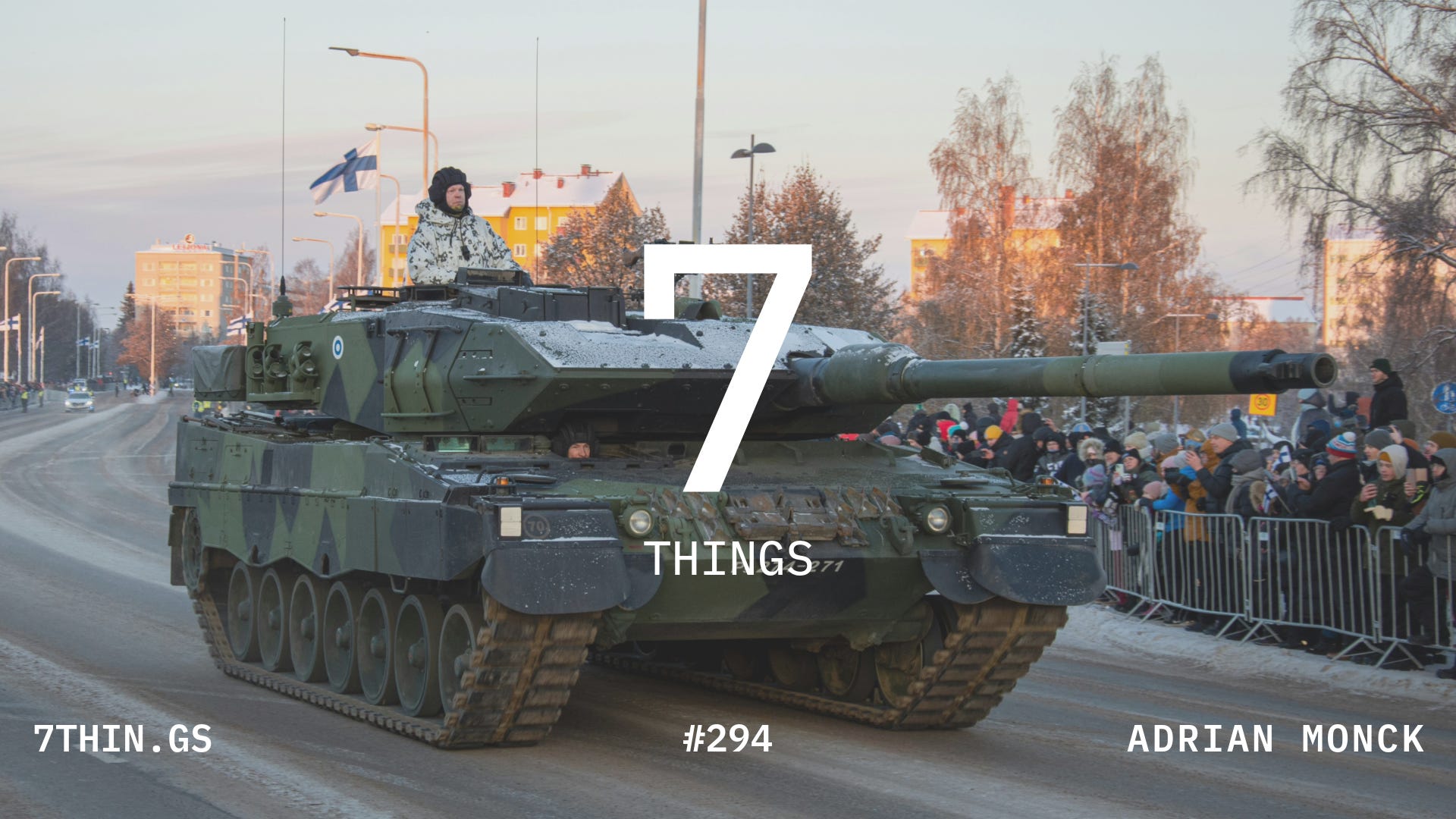
Take Germany. Rheinmetall and KNDS make the Leopard 2 – the backbone of European land forces. The Leopard 3 programme is exactly the kind of indigenous European industry this argument says Europe needs: German-designed, German-built, German jobs. Telling Berlin to shift that money towards drones and autonomous systems means telling German workers the next tank programme gets less cash.
The battlefield evidence says armour is increasingly vulnerable to cheap drones. The answer isn’t no tanks, it’s fewer of them, better protected, and surrounded by the autonomous systems that keep them alive. The Leopard 3 should continue, but at a slower pace, and with the savings going to the drones that will determine whether they survive their first engagement.
Or take Poland. Warsaw is buying American – Abrams tanks, F-35s, HIMARS – because it sits on Russia’s border and needs capability now, not in 2035. European industry simply can’t deliver at the speed and scale Poland requires. The “buy European” argument fails for the country that most urgently needs a deterrent.
For the eastern flank, American procurement isn’t a dangerous dependency – it’s survival. No argument about strategic autonomy changes that. What changes it is time: building European production capacity so that the next round of procurement, five or ten years from now, doesn’t have to be American. Poland’s urgency is real. But an urgency that locks in thirty years of defence dependency is one that risks making the problem permanent.
France is both the exception – and the warning. Paris already does what I’m arguing for here. The Rafale, the Barracuda submarine, the ASMPA nuclear missile – all domestic-made, all French. But France’s model is expensive. Its kit is capable, but not best-in-class against American equivalents.
That’s the trade-off European autonomy demands: lower performance per euro today, in exchange for industrial capacity that compounds over decades. France has made that bet since de Gaulle.
Whether the rest of Europe has the will to join is a different question.
5. The Nordic proof of concept
If you want to see what smart European rearmament looks like, look north.
Norway sits across the North Atlantic approaches and the Barents Sea – the corridor through which Russian submarines reach the open ocean. Finland shares 1,340 km of border with Russia. Sweden’s NATO accession closed the last gap in Baltic defence. Denmark guards the approaches. These four countries control the geographic pieces that makes European defence credible or hollow.
They also share something rarer: defence industries that actually work. Kongsberg in Norway builds anti-ship missiles and autonomous systems. Saab in Sweden builds fighters and submarines. Nammo – jointly owned 50/50 by Norway and Finland – makes ammunition. Finland’s Patria builds armoured vehicles. And these aren’t boutique operations. Kongsberg’s Joint Strike Missile is carried by F-35s worldwide. Nammo’s 155mm shells are what Europe is desperately short of.
Finland is spending above 2.4% of GDP and heading to 3% by 2029. Sweden targets 3.5% by 2030. Norway has committed to the full NATO 3.5% core defence target.
And that money stays in the region. A krone spent on Kongsberg missiles or Nammo ammunition circulates through Norwegian and Finnish wages, suppliers, and tax receipts. The cross-border integration is genuine. Supply chains run across borders but stay in Scandinavia.
The Nordic countries are the proof of concept. Indigenous industry makes for domestic multipliers. Capabilities can be matched to geography building weapons platforms that don’t require permission from Washington.
This is what European rearmament should look like everywhere.
It’s also, not coincidentally, the model that American policy is designed to prevent.
6. Britain’s unpublished plan
Britain has more sovereign defence capability than any European country except France.
BAE Systems builds across land, air, sea, and electronics. Rolls-Royce makes submarine reactors. The nuclear weapons enterprise at Barrow and Aldermaston is a British operation. GCHQ and Five Eyes give Britain signals intelligence no continental ally can match. The sector supports 272,000 jobs, 70% of them outside London and the South East. And exports hit a record £20 billion last year.
UK spending will rise from £62 billion this year to £73.5 billion by 2028/29 – that’s real growth. The bigger target is 3.5% of GDP by 2035. But even reaching 2.6% by 2027 will already squeeze non-defence spending to near-zero real growth.
For Britain, getting to 3.5% means either raising taxes or cutting health, education, and welfare in ways that angry voters will notice. Russian information operations know how to exploit that anger. No politician has been willing to say where the axe will fall.
And the Defence Investment Plan that would decide where this money goes? Unpublished. Missed its autumn 2025 deadline and the end-of-year. Britain has committed to spending more on defence without deciding what to spend it on.
The priorities should follow British strengths. Submarines and the nuclear deterrent are non-negotiables – the Dreadnought programme is the fixed cost that makes Britain strategically irreplaceable.
Surface ships and autonomous maritime systems are the UK’s best play: the Clyde, Devonport, and Rosyth yards are world-class, and the Royal Navy will have to fill gaps as America’s fleet heads for the Pacific. The Type 26 frigate deal with Norway is what “buy European” looks like when it works – British-built warships for a NATO ally.
Drones and AI draw on ARM’s chip architecture and a growing defence-tech sector. Munitions come from from BAE’s plants at Glascoed and on Tyneside. Electronic warfare and space systems from Leonardo UK in Edinburgh.
Munich made the American pivot visible two years in a row. Rubio, Hegseth, and Vance all talked about European security through the lens of China – not Russia, which is what European defence planning is actually for.
The Pentagon is building arms factories in Hawaii, not Hanover. US production lines are redirecting to the Pacific. Britain cannot assume American supply chains will be there for a European war.
The hardest call is GCAP – the next-generation fighter being built with Japan and Italy. It’s a multi-decade, multi-tens-of-billions commitment to a manned platform arriving in the late 2030s. By then, autonomous systems may have made it obsolete before its first flight.
The instinct is to call it a legacy programme and redirect the money. But killing GCAP doesn’t just lose a plane. It kills the design and integration skills at BAE’s Warton facility – the capability that lets Britain participate in any future combat aircraft programme. Those took generations to build. Once the engineers disperse, they don’t come back.
Keir Starmer’s Munich announcement – deploying the carrier strike group to the Arctic – was the right instinct. Britain’s advantages are maritime, nuclear, and in autonomous systems where North Sea underwater engineering and AI talent converge.
Whether the Defence Investment Plan, when it finally arrives, reflects this logic is the test. The alternative is buying platforms that feel reassuring and deliver nothing the threat demands.
7. Trumpgeld for a client continent
The money will be spent. Russia can’t demobilise. The threat is structural. The argument about whether to rearm is over.
The argument about what to buy is not. Keep the money inside European economies – the Nordics show it can be done. Buy what the battlefield says works: drones, shells, electronic warfare, sensors. Invest in R&D that builds industries, not just arsenals. Accept that this means slower delivery, inferior kit in the short run, and fury from Washington.
The alternative is four trillion euros spent on American platforms. Multipliers that accrue across the US. Industrial dependency that deepens with every purchase order. Capabilities designed for the last war while the next one plays out above Ukrainian skies.
Trumpgeld would be a very expensive way to remain a client continent.
Thanks for reading!
Best,
Adrian


An excellent companion article to the previous one. I wonder what lessons we can learn from the tighter integration of the European core in regards to this. I'd love to hear your thoughts on that next!
On a separate note, I received a few days ago a fantastic news summary by you but couldn't find it afterwards - I must have deleted it from my Inbox by accident. Will you be sending more of these?
Another very well argued thesis.