The Dire Strait: Why the US Went from Nuclear Negotiations to War on Iran in Five Days
How secret intelligence sold Trump on a spectacular strike that set the global economy on fire.
Grüezi!
The US launched its biggest military operation since Iraq two days after the most productive round of nuclear negotiations in twenty years.
The cause wasn’t a lobbying campaign, a diplomatic failure, or an intelligence assessment.
It was an opportunity too theatrical for this president to resist: the entire Iranian leadership, one location, one morning.
And now the stage is on fire.
1. The Call That Changed Everything
On Monday 23 February, Benjamin Netanyahu called Donald Trump to pass on a piece of critical Israeli intelligence. Iran’s Supreme Leader Ali Khamenei and his top advisers were planning to gather at a single location in Tehran on the next Saturday morning. Netanyahu told Trump they could all be eliminated in one strike.
The original plan — shaped by months of lobbying from Senator Lindsey Graham, retired US General Jack Keane, and the Israeli Prime Minister himself — had envisaged strikes in late March or early April, allowing time to build a public case. Israel’s Defence Minister Katz later disclosed that Israel had initially planned to strike Iran in mid-2025.
But with the intelligence received, Netanyahu pushed to speed things up. Trump asked the CIA to check.
The call did not come out of the blue. The strike track had been building for months. Israel’s Security Cabinet had authorised a new round of operations in early January, after the Iranian regime’s brutal crackdown on domestic protests; Israeli sources told the Council on Foreign Relations that a date for the attack had been agreed around the time of Netanyahu’s mid-February visit to Washington, which overlapped with the opening of the Geneva talks.
Axios captured the structure: ‘one side of the house was negotiating and the other side of the house was doing joint military planning.’
By 23 February, the operational machinery was already in motion. What the call provided was the possibility of a bloody coup de théâtre.
Netanyahu had his own reasons for urgency. Israeli elections were originally due by October 2026, but his budget was deadlocked over conscription exemptions for the ultra-Orthodox. If it couldn’t pass by 31 March, the Knesset would automatically dissolve, forcing elections by early July.
A war would freeze the coalition crisis, unite the opposition behind his government, and let Netanyahu go to the country as a wartime leader on his own timetable.
For Trump, it was simpler. The invitation to war had been dropping on his doormat for fifteen months — with Lindsey Graham coaching Netanyahu on how to present intelligence briefings, and whispering in the President’s ear at Mar-a-Lago.
And the nuclear negotiations were flagging — Trump was impatient, demanding ‘zero’ enrichment.
A single secret strike that would decapitate Iran’s entire government, executed with American arms, and announced to the world as a fait accompli — that would be something. For a president who prizes performances over processes, it was irresistible.
Everything after 23 February makes sense through this lens. On Tuesday 24 February, Trump delivered his State of the Union address. US officials told Axios he made a ‘deliberate decision’ not to emphasise Iran, to avoid alerting Khamenei and prompting him to change his movements. The speech wasn’t a missed opportunity to prepare the public. It was operational security for the weekend show.
On Thursday 26 February, the final Geneva round ran over five hours. The CIA had by now fully confirmed Israel’s intelligence.
Meanwhile, Steve Witkoff and Jared Kushner sat across from Iran’s delegation, and received the most detailed proposal Tehran had ever tabled. They agreed to continue talking. But the negotiation had become a sideshow, not the main event.
On Friday 27 February, Omani Foreign Minister Badr Al Busaidi flew to Washington and met Vice President Vance. Iran, he said, had agreed to zero stockpiling of enriched uranium — ‘the single most important achievement,’ and ‘something that is not in the old deal.’ He asked the administration to give negotiators ‘enough room and enough space.’
The same day, Trump was briefed by CENTCOM commander Admiral Brad Cooper on the strike options. Embassies started to evacuate. The USS Gerald R Ford arrived at Haifa. Trump, in Corpus Christi, said: ‘We have a big decision to make.’ He said it was ‘not easy.’ He said he wanted ‘zero’ enrichment.
At 3:38 PM EST, Trump gave the final, secret command: ‘Operation Epic Fury is approved. No aborts. Good luck.’ A few hours later the first bombs fell, early on Saturday 28 February.
The dull detail of nuclear negotiation solved in a single order that would slice the top off the Islamic Republic as simply as a spoon through a soft boiled egg.
2. What Was Actually on the Table
The temptation in Washington now is to dismiss the pre-war negotiations. Iran’s proposals were never serious, its stockpile citations were threats, walking away was the only honest option.
But Iran’s seven-page proposal, submitted on the evening of 25 February, had four important elements:
a multi-year pause on all uranium enrichment;
reducing the 440 kg of 60 per cent-enriched uranium to lower levels under international supervision;
no future stockpiling of near-weapons-grade uranium;
broader inspection oversight.
The no-stockpiling commitment was new. The Omani foreign minister explained what it meant quite clearly:
‘If you cannot stockpile material that is enriched then there is no way you can actually create a bomb, whether you enrich or don’t enrich.’
The previous negotiated agreement had capped enrichment levels and stockpile quantities.
Iran was now offering to eliminate the stockpile entirely. Was it enough?
Britain’s National Security Adviser Jonathan Powell was in the Geneva negotiating room with Witkoff and Kushner, according to the Guardian. He found the Iranian proposal ‘surprising,’ and thought ‘a deal could be done,’ but also that Iran was ‘not quite there yet, especially on the issue of UN inspections.’
Powell ‘expected the next round of negotiations to go ahead on the basis of the progress in Geneva.’ He didn’t think this was Iran’s final offer.
Technical talks were scheduled for 2 March in Vienna — with IAEA experts present. They were designed to put Iranian willingness to the test.
They were never held.
The bombing began 48 hours before the negotiators were due to reconvene. And the question of whether Iran’s offer was genuine became permanently unanswerable, which may, of course, have been part of the appeal.
3. The Delegates Not Sent to Deal
Were Witkoff and Kushner negotiating in good faith? Were they out of the secret strike loop? Or were they simply playing for time as the clock ticked down?
The Americans did not bring a nuclear technical team to Geneva. Powell, who had come with his own nuclear expert, was stunned. They relied instead on the IAEA’s Director General as their advisor — a role that was, as a former official observed, ‘not his job.’
Witkoff’s post-strike media appearances haven’t made things any clearer. A detailed analysis of recordings and transcripts from his background briefings on 28 February and 3 March by the Arms Control Association, reveal a concerning failure to grasp the matters under negotiation.
Witkoff claimed Iran’s Tehran Research Reactor (TRR) was being used for ‘subterfuge’ and ‘stockpiling’ enriched uranium. But the TRR was supplied by the US in 1967 under the Atoms for Peace programme to produce medical isotopes. It cannot enrich uranium.
He claimed the IAEA ‘has not been able to make inspections’ since June 2025. The IAEA had inspected the TRR on 22 December 2025.
He expressed surprise that Iran manufactures centrifuges — it has done so for decades.
He called Natanz, Fordow, and Isfahan ‘industrial reactors.’ They are enrichment and conversion facilities.
He said Iran ‘has been testing for weaponisation since 2003’ — contradicting the 2007 National Intelligence Estimate, the 2015 IAEA assessment, and his own government’s 2025 Worldwide Threat Assessment, all of which concluded that Iran’s organised weapons programme ended in 2003.
On Fox News on 3 March, Witkoff told Sean Hannity that the Iranians had bragged about their stockpile — ‘460 kilograms of 60%, and they’re aware that that could make 11 nuclear bombs, and that was the beginning of their negotiating stance.’
The Iranian Foreign Minister’s version of events was somewhat different:
‘I never said that we are going to make the bombs. I said that we have 440 kilos of 60% enriched material, and that was not a secret … we are ready to give them up. The concession that we are making is really big.’
One may not give Iran’s version much credence, but a Gulf diplomat with direct knowledge of the talks told MSNBC that it was Witkoff’s characterisation that was ‘false’ and that the Iranians were describing ‘what they were willing to give up.’
None of this necessarily means that the US negotiations were not in good faith, but it hardly inspires confidence.
4. 9:32 AM Tehran Time
At approximately seven in the morning Tehran time on 28 February, the strikes began. CENTCOM reported ‘a massive, overwhelming attack across all domains.’ Around 900 US strikes took place in the first twelve hours. Israel launched some 200 fighter jets against 500 targets.
At 9:32 AM local time, an Israeli strike hit Khamenei’s compound. He was killed at his residence office, alongside family members including his daughter, a grandchild, and a son- and daughter-in-law.
Defence Minister Nasirzadeh, IRGC Commander Pakpour, Defence Council Secretary Shamkhani, Chief of Staff Mousavi, and dozens of other senior Iranian officials were killed across multiple locations. CBS reported 40 top figures killed, some of whom had been identified by the US and Israel as potential ‘pragmatic’ replacements.
The Supreme Leader’s son, Mojtaba Khamenei, who had stepped outside into the garden, survived by chance. He was named Supreme Leader on 8 March, reportedly under pressure from the IRGC. But he has not appeared publicly, fuelling speculation about the severity of his injuries.
Iran retaliated within hours.
Since then, the war has spread to Lebanon — with Israel conducting a ground invasion to the south and striking Beirut — and across the Gulf.
The IDF has conducted more than 7,600 strikes in nearly 5,000 sorties.
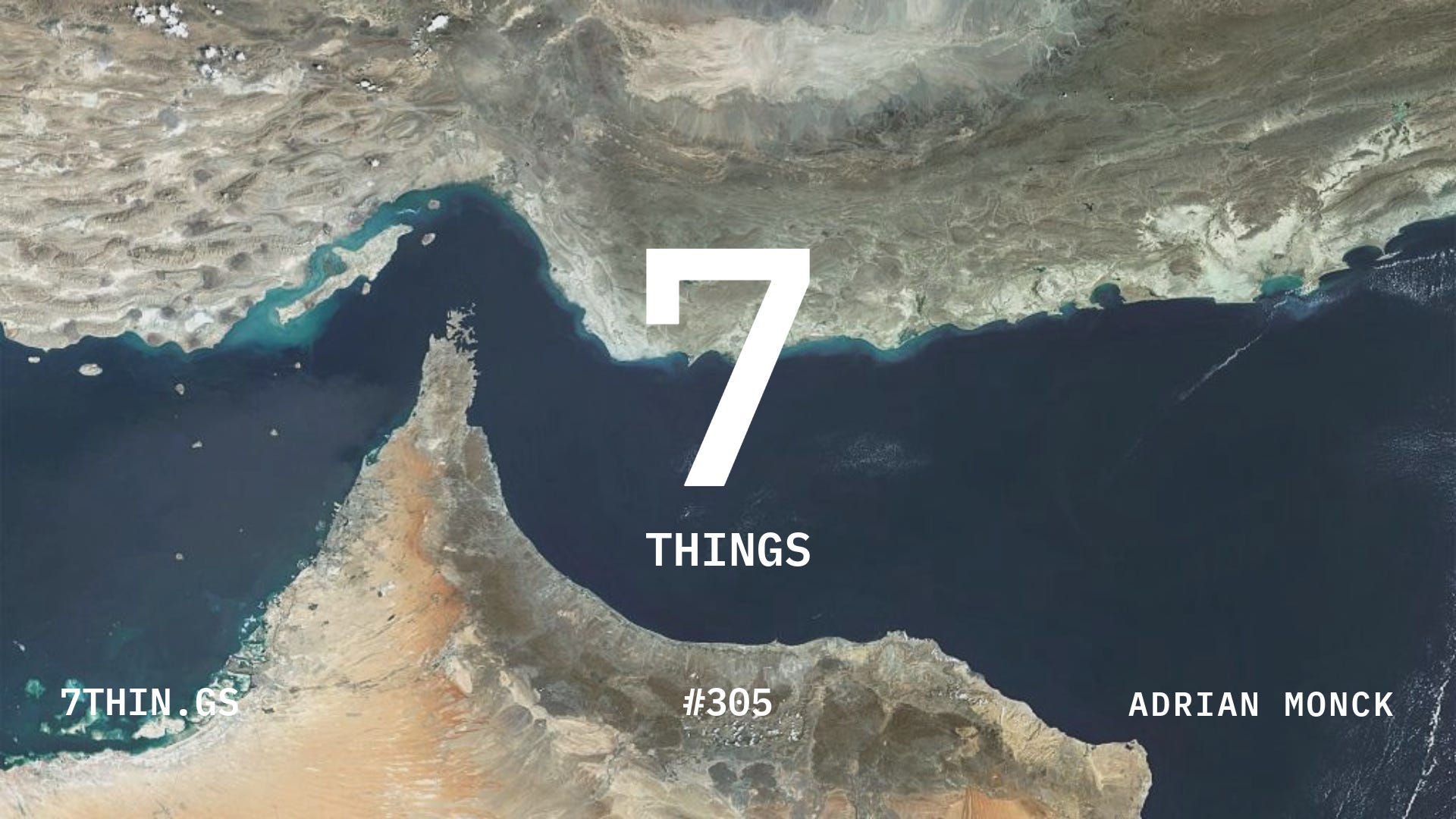
Iran has launched missiles and drones against at least nine countries, but critically it has done what it always threatened to do and brought one of the world’s great shipping arteries to a standstill.
5. The Dire Strait
Iran declared the Strait of Hormuz closed on 4 March. The IRGC has said it will not allow ‘a litre of oil’ through. Roughly 500 oil and gas tankers and 500 container ships sit stranded either side. The IEA estimates the war will cut global oil supply by about 8 million barrels a day this month alone.
The IEA has authorised the release of 400 million barrels from emergency reserves — the largest coordinated drawdown ever — but at current consumption rates, that covers roughly four days of global demand.
Gulf producers have haemorrhaged revenue; One estimate puts Saudi Arabia’s losses at $4.5 billion since the strikes began. QatarEnergy, the world’s second-largest LNG exporter, shut down production entirely after Iranian drones struck Qatari gas facilities, with knock-on effects on global helium and fertiliser markets. Urea, crucial for the fertiliser supply chain, is up 35 per cent since 28 February.
The US has dropped 5,000-pound bunker-busters on hardened Iranian missile sites along the Strait’s coastline. It has discussed naval escorts for tankers. There is talk of taking Iran’s Kharg Island in the middle of the Strait.
Energy Secretary Christopher Wright told CNBC that escorts might begin ‘by the end of March’ — at best. Trump has demanded seven countries send warships. Germany has said it has ‘no intention’ of joining. The EU foreign policy chief noted European nations have ‘no appetite’ to send troops.
Trump told NATO allies and Indo-Pacific partners they were ungrateful, then declared the US ‘does not need the help of anyone.’
He has delayed his end-of-March trip to China, telling reporters: ‘We’ve got a war going on.’
Opening the Strait requires either Iran’s cooperation or its military defeat in the waterway. The first demands a negotiation. The second demands sustained naval operations in confined waters against an adversary whose entire defensive doctrine was built for this scenario.
Iran has allegedly laid mines. Ships have been attacked. Insurance costs have become prohibitive.
And the IRGC has warned: ‘If you can tolerate oil at more than $200 per barrel, continue this game.’
Trump wants the Strait open. Iran doesn’t. And overwhelming firepower has not yet changed that equation.
6. The War That Ate Its Own Off-Ramp
There is no mechanism for how this war ends.
The war’s brutal mic-dropping opening act destroyed the three components from which a settlement might be built.
No interlocutors. The people with whom deals are made are being methodically eliminated. It is genuinely unclear who, on the Iranian side, could negotiate peace and who could deliver it.
No credibility. US negotiations, post Maduro and post Geneva look like PR stunts meant to buy time, gain information, and conclude with more military action. Coercion doesn’t work when the target concludes it will be punished regardless of how it behaves. Iran negotiated, conceded, agreed to technical talks and was bombed two days later. The lesson isn’t hard to learn.
No incentives. Araghchi, the Iranian foreign minister who sat across the table in Geneva eighteen days ago, now says: ‘We are ready to defend ourselves as long as it takes.’ This isn’t posturing. It is rational. And it extends beyond Tehran. If you wanted to rally support for nuclear proliferation, you could hardly improve on the week of 23–28 February 2026.
7. Not the War They Started
Days and now weeks in, the declared objectives have already shifted. The reversal of the war’s unintended, predictable consequence – the closure of the Strait of Hormuz – is now its principal aim.
Trump wanted something dramatic and decisive: a decapitation, followed by capitulation or collapse. The crisis that’s actually unfolding is slower, wider, and more insidious — an energy shock reverberating through oil, gas, fertiliser and shipping markets, another Khamenei in Tehran with the Revolutionary Guard pulling the strings, a spreading war pulling in Lebanon, Iraq, and the Gulf states, a delayed presidential trip to Beijing.
And the original justification for it all?
Helping a harassed allied prime minister win another election victory and stay one step ahead of his own country’s courts?
Preventing Iran from building a nuclear bomb with resources US intelligence said had been ‘obliterated,’ and which Iran now says lie ‘under the rubble’?
28 February’s coup de théâtre set fire to the stage.
What is left to Iran is to cause trouble.
Suez shattered the illusion of Anglo-French military power.
Hormuz may well shatter another illusion – that American might let the global economy sleep at night.
Thanks for reading,
Best
Adrian


Another self-inflicted wound - and things will only get worse, I'm afraid. Are MAGA tired of all this winning, I wonder?