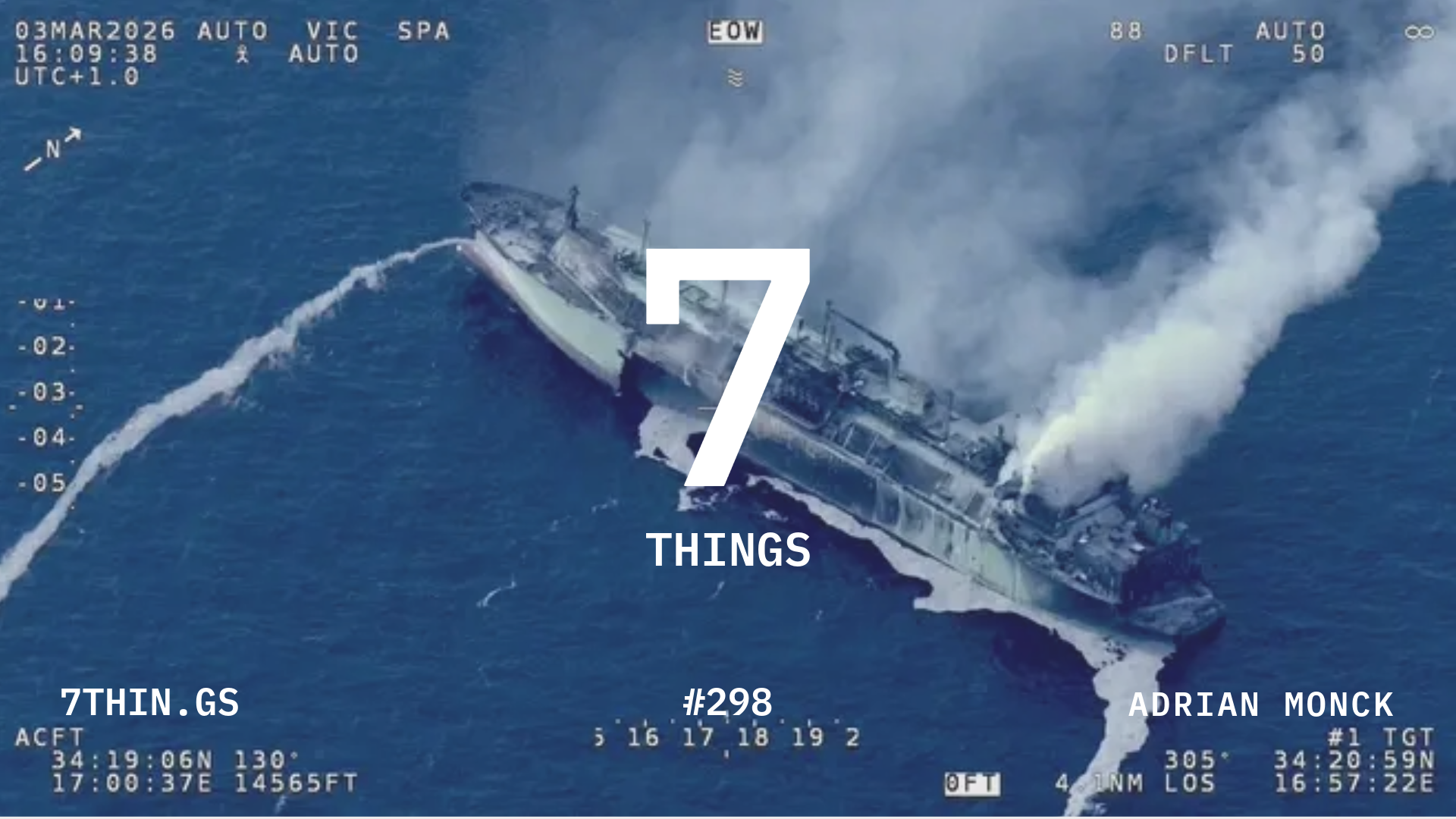
The Strait Truth
How the Hormuz crisis exposed Europe’s energy dependency – again
Grüezi!
Three of the world’s major energy chokepoints are closed or contested at the same time – the Strait of Hormuz, the Red Sea, and the central Mediterranean.
The conventional reading sees this as an oil shock. It’s not. It’s a gas shock – and specifically a crisis for Europe which replaced one energy dependency with another without ever admitting what either cost.
1. Not 1973
When energy chokepoints close, the instinct is to reach for the 1973 analogies: embargoes, oil shocks, recessions.
And commentary has been doing exactly that since the US and Israel launched Operation Epic Fury against Iran. Brent has jumped from the mid-$60s to the $80s. OPEC+ has offered a token 200,000 barrel-per-day increase. The word ‘crisis’ is everywhere.
The 1973 comparison is wrong in almost every way, but the wrongness is instructive. In 1973, oil was what mattered, OPEC controlled its supply, and its weapon was deliberately turning off the taps.
Today, the commodity that matters is gas, and it’s not the West at risk but Europe which replaced Russian pipeline supply with American liquid natural gas – a cargo whose price is determined at awkward places like Hormuz.
Tanker transits dropped from 50 on February 28 to just three on March 1. Iran made the strait unsafe. Then the insurance market made it unusable. Protection and indemnity clubs cancelled war risk coverage across the Persian Gulf and Gulf of Oman. No coverage means no transit, regardless of what any navy or government promises.
The Trump administration’s response was to order the US Development Finance Corporation to offer American taxpayer-backed political risk insurance for Gulf shipping, with naval escorts if necessary.
It remains to be seen if that can substitute for commercial coverage, and whether or not shipowners will test that promise in two-mile-wide sea lanes, with tankers trudging past Iran’s islands at ten knots. A US destroyer can intercept missiles but can it simultaneously sweep mines, counter drone swarms, and manage GPS disruption for a convoy?
In the Red Sea in 2024, the US-led task force downed nearly 400 Houthi drones and missiles – without restoring commercial traffic. The military won every engagement and lost the campaign.
2. Crude Awakening
But let’s start with oil, because it’s the simpler story. Around 20 per cent of global crude goes to market through Hormuz – Saudi, Iraqi, Kuwaiti, Emirati, and Iranian barrels headed mostly for Asia.
With the strait contested, Iraq is already shutting its largest fields because it cannot export and has nowhere to store the output.
The cost of shipping oil from the Gulf to China nearly doubled in a single day, hitting a record $424,000 per supertanker per day on March 3. China had been importing around 1.5 million barrels per day of discounted Iranian crude – all via Hormuz. But Beijing has ample strategic reserves and decades of experience managing supply shocks.
India’s position is more precarious. It is the world’s third-largest oil consumer, importing nearly 90 per cent of its crude, but with reserves that will last about 10 weeks. China has a month’s more.
Indian refiners are pivoting hard to Russia: Urals blend has risen from around $40 in December towards $60. Moscow is rubbing its hands together, because that just happens to be Russia’s budget breakeven. The G7 price cap is functionally dead. India’s compliance was always voluntary; and now it’s not even pretending.
But the oil crisis, whilst tough, is ultimately more manageable than the gas crisis. The world entered this war oversupplied.
The EIA had projected a surplus of nearly 2 million barrels per day for 2026. Before Epic Fury, Brent was forecast to average $58 for the year.
Those pre-war fundamentals haven’t disappeared. They’re just buried under a risk premium, and if the strait reopens within weeks, they’ll reassert themselves.
Gas is very different.
3. Flexibility Becomes Fragility
The great promise of the LNG revolution was resilience. Pipelines are rigid – they connect a specific producer to a specific consumer, and when the relationship breaks, there’s no alternative.
Liquefied natural gas moves on ships. It can be redirected, rerouted, and sold on to the highest bidder. The LNG market is global, and it was supposed to be the energy equivalent of the internet: a distributed network, robust against any single point of failure.
That resilience isn’t looking so good.
Three things happened in the space of three days.
On February 28, Yemen’s Houthis announced they’d be resuming attacks on Red Sea shipping, ending a four-month ceasefire pause.
Maersk and CMA CGM immediately suspended Red Sea transits, re-closing the Suez alternative. On March 1, the insurance withdrawal shut Hormuz.
On March 2, Iranian drone strikes hit the world’s largest LNG export facility, Qatar’s Ras Laffan complex responsible for a fifth of global supply, forcing QatarEnergy to tell customers it couldn’t deliver.
The market reaction was instant. Europe’s benchmark gas price nearly doubled in two days. Asian spot prices jumped 40 per cent. Goldman Sachs warned that if Hormuz stays closed for a month, prices could match the levels that forced European factories to shut down after Russia’s Ukraine invasion in 2022.
The comparison to 2022 should alarm European policymakers, because the starting position is much worse.
EU gas storage was at 30 per cent of capacity going into March. The heating season is coming to a close, which buys some time. But Europe needs to refill its tanks over the summer to get through next winter, and it will have to do that with Qatar offline and Hormuz closed which means competing against Asian buyers for every spot cargo at prices that could kneecap what remains of European industrial competitiveness.
The LNG fix failed because a distributed network routed through a small number of bottlenecks isn’t distributed at all.
The ships can go anywhere; the gas has to come from somewhere.
And there aren’t enough ‘somewheres.’
4. Europe’s Serial Dependency
Here is what turns a supply shock into an affordability crisis. American LNG doesn’t sail through Hormuz. But the price of it does.
China holds enormous strategic reserves and long-term Qatari contracts. It is better positioned than Europe to ride out a short closure. But if China starts buying spot cargoes anyway, as it did in late 2021, it becomes the marginal price-setter that pushes European costs to catastrophic levels.
It is not even a Chinese shortage that would break Europe. It is China’s precautionary buying. In a global LNG market, fear of running out is indistinguishable from shortage itself.
That connected market is the product of decisions Europe made.
In 2021, Russia supplied almost half of the EU’s gas imports, mostly through pipelines. By 2025, after the invasion of Ukraine and a quarter-trillion-euro scramble to build LNG import terminals and sign new deals, Russian gas had fallen to about 13 per cent. The EU congratulated itself on a historic diversification.
It was nothing of the kind. EU imports of American LNG rose from 21 billion cubic metres in 2021 to 81 billion in 2025 – almost quadrupling. By late 2025, the US was supplying 60 per cent of the EU’s LNG.
Germany – which had no LNG terminals before 2022 – sourced 94 per cent of its LNG from the US in the first half of 2025. Under the EU-US trade deal signed in July 2025, Europe committed to purchasing $750bn worth by 2028. By 2030, the US could be supplying over three-quarters of Europe’s LNG.
Europe didn’t escape dependency. It swapped.
The price of Russian gas was turning a blind eye to Russian adventurism. Georgia in 2008. Crimea in 2014. Each time, Europe huffed and moved on – because cutting off Moscow meant cutting off cheap gas. Putin learned the lesson. The 2022 invasion was the last bet on a gamble that had come good twice before.
The price of American LNG dependence is different. Russia’s leverage was a state monopoly that could turn off the taps, and did.
American companies sell to the highest bidder, and the US is unlikely to weaponise gas supply quite the way Russia did. But then it doesn’t need to.
The tariffs, the weapons orders, the unilateral deals over Ukraine – none of them are framed as energy leverage. They don’t need to be. The dependence does the work quietly because subordination, or simply being ignored, is harder to mobilise against.
The Gulf crisis shows what this means in practice. American LNG isn’t physically threatened by the Hormuz closure – it ships from the Gulf of Mexico, not the Persian Gulf.
But with Qatar offline and Asian buyers scrambling, US cargoes will flow to whoever pays the most.
Europe is competing for its own contracted supply at prices set by panicked Asian customers, using expensive infrastructure it built in haste to escape a different trap.
5. From Gas to Grain
Natural gas is not just an energy source. It is the primary feedstock for nitrogen fertiliser. The Haber-Bosch process – the chemistry that turns atmospheric nitrogen into ammonia, and then into urea – consumes nearly 5 per cent of global gas production.
Fertiliser isn’t an optional input. It’s the reason the world can feed eight billion people.
Qatar, Saudi Arabia, and the UAE are amongst the world’s largest urea exporters, a competitive advantage rooted in cheap Gulf gas. With Qatari production at a standstill and Gulf shipping paralysed, the fertiliser supply chain is grinding to a halt just as spring planting begins across South and Southeast Asia.
India imports Qatari gas to make its own fertiliser. And it imports 10 million tonnes of urea a year from Gulf producers who use the same gas. Both sources are now offline. Petronet LNG has told customers it cannot deliver. And gas supplies to Indian industry have been cut by 40 per cent.
Before a single US or Israeli missile struck, the fertiliser market was already strained. China had restricted urea exports by more than 90 per cent in 2024 to stabilise domestic prices. The EU put tariffs on nitrogen imports from Russia and Belarus. Urea prices rose 15 per cent through 2025.
If disruption carries on into April, the planting window gets narrower and fertiliser won’t be available at any price in some parts of South Asia and sub-Saharan Africa.
That is no longer an energy story. It is a food security story – and it will outlast whatever happens at Hormuz by at least one growing season.
Nor, when the shock came, did the energy transition offer an escape route. Across Asia, the immediate response to the LNG crisis has been a scramble back to coal.
6. The Diversification Delusion
Everyone knew there were bottlenecks. Everyone knew they were dangerous. The revelation is that Europe's entire post-2022 energy security framework didn’t address them.
When Europe shifted from Russian pipeline gas to global LNG, it swapped an abusive partner for an expensive one. It did not become less dependent.
Nor did it seek to establish the kind of force that could protect or patrol the places whose security and safety kept the prices down.
In 2024, the Houthis demonstrated that an armed group with off-the-shelf missiles could functionally close the Suez Canal despite a multinational naval flotilla. Ukraine appears to have demonstrated that sea drones can sink an LNG tanker in the middle of the Mediterranean.
Real security would have required something else entirely: less gas altogether, more domestic generation, and demand reduction aggressive enough to make import dependency tolerable rather than existential.
Europe has the policy architecture to do this – the Green Deal, Fit for 55, REPowerEU.
Complacent industrialists, politicians and voters have combined to ensure that it does not have the will.
7. Duration, and After
Everything now is time.
If the Hormuz reopens in days, this is a nasty but manageable shock – prices will settle, the refill season will start late, European industry can limp through the summer.
If it lasts weeks, Europe will face empty tanks, soaring refill costs, and an industrial demand crisis that will hit Germany, the Netherlands, and Belgium hardest. And they’re already losing ground.
The political pressure to reopen some form of Russian gas trade will become intense, potentially collapsing the EU’s sanctions consensus before its legal bans take effect.
Vladimir Putin is already trolling Europeans, telling a journalist Russia needs more “reliable” partners.
If the crisis lasts months, Europe would face a choice between enforcing its ban on Russian imports and ensuring its citizens can heat their homes.
Russia – which still pumps gas to Europe via TurkStream and whose LNG tankers still supply France, Spain, and Belgium – is positioned for exactly this moment.
Before Epic Fury, the oil market was oversupplied, electric vehicles were taking out demand at record rates, and new US LNG capacity was coming on stream fast.
But the world routes a fifth of its oil and LNG through a narrow, hostile strait that a superpower and its local ally have turned into a war zone.
And the consequences require a transformation that needs massive capital reallocation, industrial retooling, and a political consensus sustained over a decade or more.
It’s exactly the kind of long-term collective effort that seems impossible.
Can a hotchpotch of different nationalities, competing regions, riddled with bureaucracy and mired by corruption, hobbled by a hostile hegemon undertake such a project?
Ask China.
Thanks for reading!
Best,
Adrian