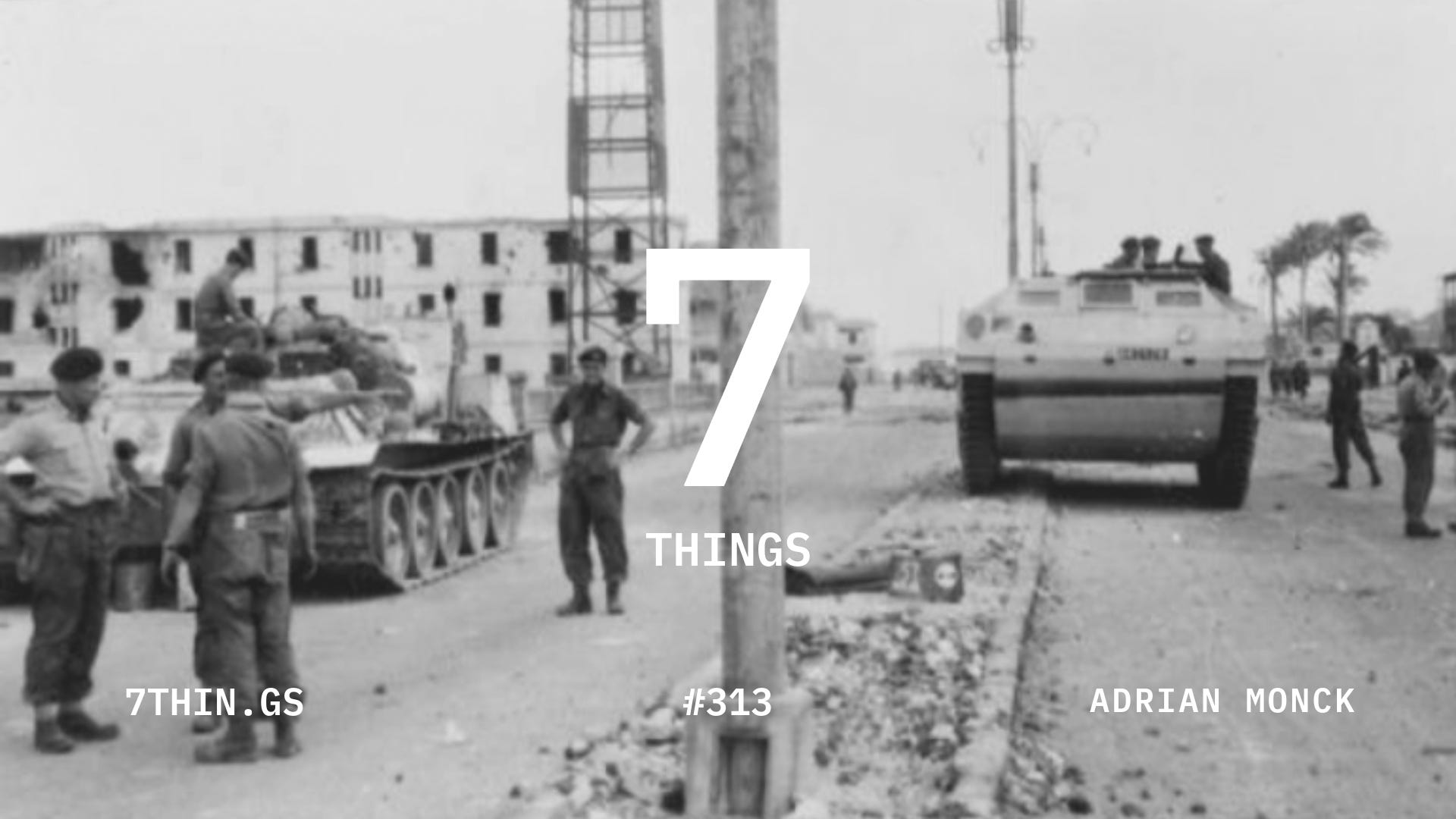
Hormuz As America’s Suez – With One Crucial Difference
Britain in 1956 had Eisenhower to force a reckoning. Washington in 2026 has no one.
Grüezi!
Indian television asked me seven questions this week about whether Hormuz is America’s Suez and what a post-US order might look like.
They’re the right questions, but they assume a successor is waiting in the wings: one power out, another one in, a tag-team relay.
Britain in 1956 was bullied out of Suez by Washington, which held the global purse strings. Eisenhower spent his geopolitical capital crushing the independence of his erstwhile ally, as Soviet tanks rolled uncontested into Budapest.
Suez called Britain’s strategic bluff. Its post-imperial military still packed a punch, but its post-war economy had a glass jaw. It could pose as a global power at the UN Security Council, but the world knew that the British bulldog was on a leash held by Washington.
Today, some argue that Hormuz has left American power looking equally fragile. Is that true?
1. Suez Was an Ending. Hormuz is an Opening.
1956 is everybody’s favourite analogy for today’s geopolitical moment, and it is worth recovering what actually happened.
In a single seven-day window, America’s 34th president, Dwight Eisenhower, chose to spend his nation’s coercive capital disciplining his own allies rather than contesting Moscow’s suppression of the Hungarian uprising.
The Anglo-French ultimatum to Egypt expired on 30 October. Soviet tanks took Budapest on 4 November. Washington’s response to Moscow was a UN General Assembly resolution and an offer of refuge to Hungarians who could escape. Washington’s response to London and Paris was financial war.
The US blocked a $561 million IMF standby loan, refused a $600 million credit line, and threatened to dump US-held sterling bonds. Between 30 October and 2 November, the Bank of England lost $45 million in reserves. Saudi Arabia imposed a selective oil embargo on 6 November. Barely a month later, Britain committed to withdraw from Suez as the price of IMF access.
Suez didn’t cause Britain’s decline – it revealed it. After the Second World War, Britain got a quarter of Germany to run and a seat on the UN Security Council, but it paid for a symbolic victory with the punitive 1945 Anglo-American Loan, the sterling area’s structural deficits, and war exhaustion. Washington barely had to pull on a couple of financial strings to humiliate London and get it to reverse course.
The lesson Ben-Gurion drew from those same seven days shaped Israeli strategic doctrine for the next half-century. European guarantees were worthless. The Americans had chosen to discipline Paris and London rather than contest Moscow.
The only insurance that mattered was alignment and the bomb. Israel went for nuclear power at Dimona, rebuilt its relationship with Washington from the ground up, and systematically dismantled the assumption that London or Paris could be relied on for anything strategic. The Israeli 1956 takeaway was not “find better allies.” It was autonomy first, America second.
Hormuz in 2026 has a different set of issues and tensions. After the joint US-Israeli strikes killed Ali Khamenei on 28 February, Iran closed the strait. Insurers withdrew war-risk cover, sending oil prices rocketing.
Trump, having failed to get allies on board before acting, demanded NATO and China send warships to reopen the strait. Britain, Germany, Italy, Spain and Japan refused. As Kaja Kallas said for the Europeans: nobody was ready to put their people in harm’s way. Beijing declined.
There is no external power putting the squeeze on Washington. Saudi Arabia is backing the US operation, not embargoing it – the opposite of 1956. Treasuries remained bid through the crisis. The dollar did not crack.
But Iran has done to the US Navy in the Gulf what Ukraine did to Russia in the Black Sea. It has exerted control over a key piece of water without the ships or aircraft of a conventional navy. The most consequential outcome for America is the line being drawn on the limits of its own coercive power – far more damaging than any battlefield result.
Kindleberger’s test of hegemony was whether the world’s leading power could keep the sea lanes open. The Brent-WTI spread is the answer.
Afghanistan, Syria and Ukraine have all hinted at a bigger problem for the world’s policeman. Trump is just the accelerant.
2. Multipolar Mishaps
Multipolar orders are historically less stable than hegemonic ones, not more. Bipolarity (the Cold War) was arguably more stable than either. The nineteenth-century Concert of Europe held for about a century, but only because it had explicit rules of engagement that the current system lacks, and it still collapsed when those rules broke down.
A hegemonic order is a one-stop shop. It has one actor who internalises the full benefit of providing public goods — freedom of navigation, reserve currency, nuclear umbrella, lender of last resort — and therefore provides them even when the cost falls mostly on itself.
In a multipolar system, nobody internalises enough of the benefit to bear those costs alone, and the goods get under-provided. Hormuz is a textbook case. The crisis has settled into a paradoxical equilibrium in which neither Iran, the US, China nor the Gulf states can impose a settlement, because none has both the capacity and the will.
Expect more chokepoint crises that simply linger on. Expect trade disputes to stay unresolved. Expect regional wars to be harder to end.
The counter-argument is worth engaging with. Mark Carney and Ursula von der Leyen, in slightly different ways, have made the case that a multipolar world disperses risk, so no single actor can drag the system into its domestic traumas the way the US has under Trump.
The dull, necessary work of international cooperation can still get done. The 2022 WTO Agreement on Fisheries Subsidies came together despite active US disengagement. A coalition of half a dozen Global South states supplied the final push. COP28’s loss-and-damage fund passed without serious US leadership. Issues do get addressed when the US is absent, sometimes better.
But the cases where multilateral cooperation survives US withdrawal tend to be those where the US was already lagging. On security guarantees, reserve currency function, and lender-of-last-resort provision, nobody else has the capacity.
A post-US order will be more balanced in the sense that no one can dictate terms, and less stable in the sense that things that used to get strong-armed into resolution won’t.
And that is a materially worse world for small and middle states than the one that is ending.
3. The World Blank
How will emerging powers reshape global institutions if the US steps back? The evidence from the past two decades says otherwise.
UN reform has been promised for twenty years and delivered incrementally at best, because existing beneficiaries hold vetoes and use them.
In November 2025, the G4 (Brazil, Germany, India and Japan) made a Security Council push, throwing in two new African permanent seats as a coalition-building concession — the latest version of a proposal that’s been on the table since at least 2005.
Russia backed just India and Brazil. China conditioned its support for India on decoupling from Japan (which is a way of saying “no” while appearing to say “maybe”).
On top of that there’s the “Uniting for Consensus” bloc – Italy, Spain, Pakistan, Argentina, Mexico, South Korea – which opposes any new permanent seats. Good luck.
All the current action is in parallel institutions. The Asian Infrastructure Investment Bank now has 111 members and can borrow on global markets at rates close to the World Bank’s. Neither the US nor Japan is a member.
China’s own payment system, CIPS, processed the equivalent of $24.5 trillion in 2024, up more than 40 per cent on the year before, across 124 countries.
Middle East volatility has pushed oil counterparties onto the renminbi in volumes that would have been unthinkable five years ago. Project mBridge, the cross-border digital-currency platform run by the central banks of China, Hong Kong, Thailand, the UAE and Saudi Arabia, has settled more than $55 billion.
The shadow template is the BRICS New Development Bank, the Shanghai Cooperation Organisation, the AIIB and now CIPS and mBridge. Any new order will emerge alongside, not in a head-on confrontation. The World Bank and IMF will persist and become less central.
The US has spent two decades selectively opting-out of a globally-negotiated “rules-based order” – the ICC, UNHRC withdrawal, WTO Appellate Body blockage, Paris withdrawal in 2017 and then again in 2025. Others are learning.
4. Greenback Pay Backers
COFER data doesn’t show the dollar down and out. The IMF release for Q4 2025 puts the dollar at 56.8 per cent of allocated official reserves, down from 56.9 per cent in Q3 and from the low-70s at the turn of the century. The euro is at 20.25 per cent, the renminbi at 1.95 per cent, other named currencies at 14.90 per cent.
Adjusted for exchange-rate movements, the dollar’s share held steady across 2025 – most of its nominal decline is the yen and euro appreciating rather than the dollar being sold. SWIFT’s currency-of-payments data for mid-2025 put the dollar at just under a half, the euro just under a quarter, and the renminbi at a tiny fraction.
Trump’s Truth Social threat of 100 per cent tariffs on “dollar deniers” landed on a project that was already politically dead.
The BRICS common-currency project has been quietly shelved. Lula’s 126-point Rio declaration in July 2025 didn’t mention de-dollarisation or a common currency. Putin at Valdai in November 2024 said Russia has not sought to abandon the dollar and is not seeking to do so. Jaishankar in London in March 2025 was blunter: India has no policy of replacing the dollar; the dollar as reserve currency is the source of international economic stability, and the world needs more stability, not less.
Perhaps the numbers haven’t caught up. But what has changed is the functional layer.
Russia-China trade is 99.1 per cent settled in roubles and yuan according to Russia’s Finance Minister. In 2024, Russia-Iran bilateral trade was 95 per cent done in rials and roubles. India has opened direct rupee-settlement arrangements with 30 countries, bypassing the dollar entirely.
In early 2024, PetroChina settled an oil purchase from the UAE in digital yuan. A small transaction, but a bigger precedent. And gold is creeping back into vaults. Central banks added 800 tonnes of it in 2025, with combined BRICS holdings above 6,000 tonnes.
The dollar’s store-of-value and unit-of-account functions remain sticky, but its means-of-payment function is being bilaterally bypassed with increasing success.
But US financial coercion – sanctions, secondary sanctions, dollar clearing access – now works on a shrinking share of the world economy each year.
The exorbitant privilege, worth roughly 40 basis points in US borrowing costs, is being slowly arbitraged.
Sterling took six decades to cede to the dollar, and multi-currency equilibria are the historical norm.
But decline is decline, drip by drip.
5. Middle Power Earth
Mark Carney’s January Davos address is the most interesting diplomatic moment of 2026 so far.
Carney put a name to what everyone had whispered – a rupture in the world order, the abandonment of agreeable Atlanticist fictions, and the return to a Hobbesian reality where geopolitics was nasty and brutish.
The diagnosis was brilliant. The remedy? Less so.
What was the recommended middle-power response that Carney had up his sleeve? He and Finland’s Alexander Stubb proposed “values-based realism.” A TPP-EU trade bridge creating a 1.5-billion-person bloc. Critical-minerals buyers’ clubs. A Nordic-Baltic flank security commitment. AI cooperation to fight hegemons and hyperscalers.
These are the kinds of smart, technocratic solutions that attract no one.
Coalitions will form. Trade and industrial policy is the most workable terrain. The Trans-Pacific trade pact that the US walked away from in 2017 is kept alive by Japan, Canada, Australia and eight others, and now includes the UK. This is a “middle-power coalition” that functions. It’s a possible vehicle to coordinate responses to US and Chinese economic muscle-flexing.
Technology governance comes next – AI rules, semiconductor supply chains, critical minerals, are all areas where the EU, Japan, South Korea, Canada and Australia share enough interest to act. Climate and green industrial policy continues despite US withdrawal.
Security is the hardest case, because hard-power coalitions among middle powers without a security guarantor are historically rare and fragile.
Every middle power faces the temptation to cut a bilateral deal.
Expect issue-by-issue coalitions that work. Do not expect a coherent middle-power bloc.
6. The World With No Bouncer
Ben-Gurion’s 1956 Suez response was not one move but two. He chose attachment to America, with Kennedy’s Hawk missile sales in 1962 and Israel’s strategic partnership hardened after 1967. But he first chose strategic autonomy, building nuclear weapons at Dimona with French help from 1957, so that attachment would never be the only guarantee.
Autonomy was insurance against the attachment failing. The middle powers of 2026 have only the second option. Attachment is closed: there is no rising alternative.
China has the financial scale in theory but not the political appetite, or the strategic reach. It declined to underwrite even the symbolic Hormuz coalition Trump requested.
The EU is barely containing a war in Ukraine on its own borders and cannot project power beyond them.
No single power has the three things Washington had in 1956: the financial leverage to punish, the military reach to substitute, and the political will to act.
What remains is the Dimona half of Ben-Gurion’s answer, and that’s what Washington has not absorbed.
Suez did not merely reveal Britain’s decline. It disciplined it. Eisenhower broke Eden’s government – he resigned in January 1957, officially on health grounds, actually because Washington had made his position untenable – and left Macmillan to execute the reckoning.
The British response to humiliation was inspired: they invented the “special relationship,” an unreciprocated, platonic affection that took the place of resentment and allowed them to walk alongside the Americans as if by choice rather than compulsion.
Britain in 1956 had a specific vulnerability that forced it to step aside. America’s only vulnerability in 2026 is itself.
Of the three big global functions it performed, rule-making is largely lost already — you don’t write what’s agreed in a room you’ve already left.
Rule-shaping through coercion remains formidable. Secondary sanctions reach anyone using dollar clearing. Export controls on chips and chip-making tools have genuinely slowed Chinese semiconductor progress. Tariff threats move economies. The US can still break things it does not like.
Public-goods provision is the function fading fastest. Freedom of navigation, lender of last resort, nuclear umbrella extended to allies – each is being questioned or scaled back.
And unlike 1956, there is no obvious candidate to pick up the pieces.
7. The Question That Actually Matters
Britain didn’t volunteer for the reckoning of 1956. Eisenhower imposed it. The US in 2026 has no one playing that role.
The dollar has held up, but the global guarantee has not. Allies have said no.
Middle powers are being left to build the scaffolding of a world that does not run on American underwriting, quietly, without a banner.
It is the repricing of the American order to something closer to its actual price, and the slow, uncomfortable emergence of a world where no one is in charge, no one particularly wants to be, and everyone has an interest in someone else’s instability.
That is a new problem.
The evidence from Hormuz is that we are nowhere near to solving it.
Thanks for reading!
Bis bald,
Adrian