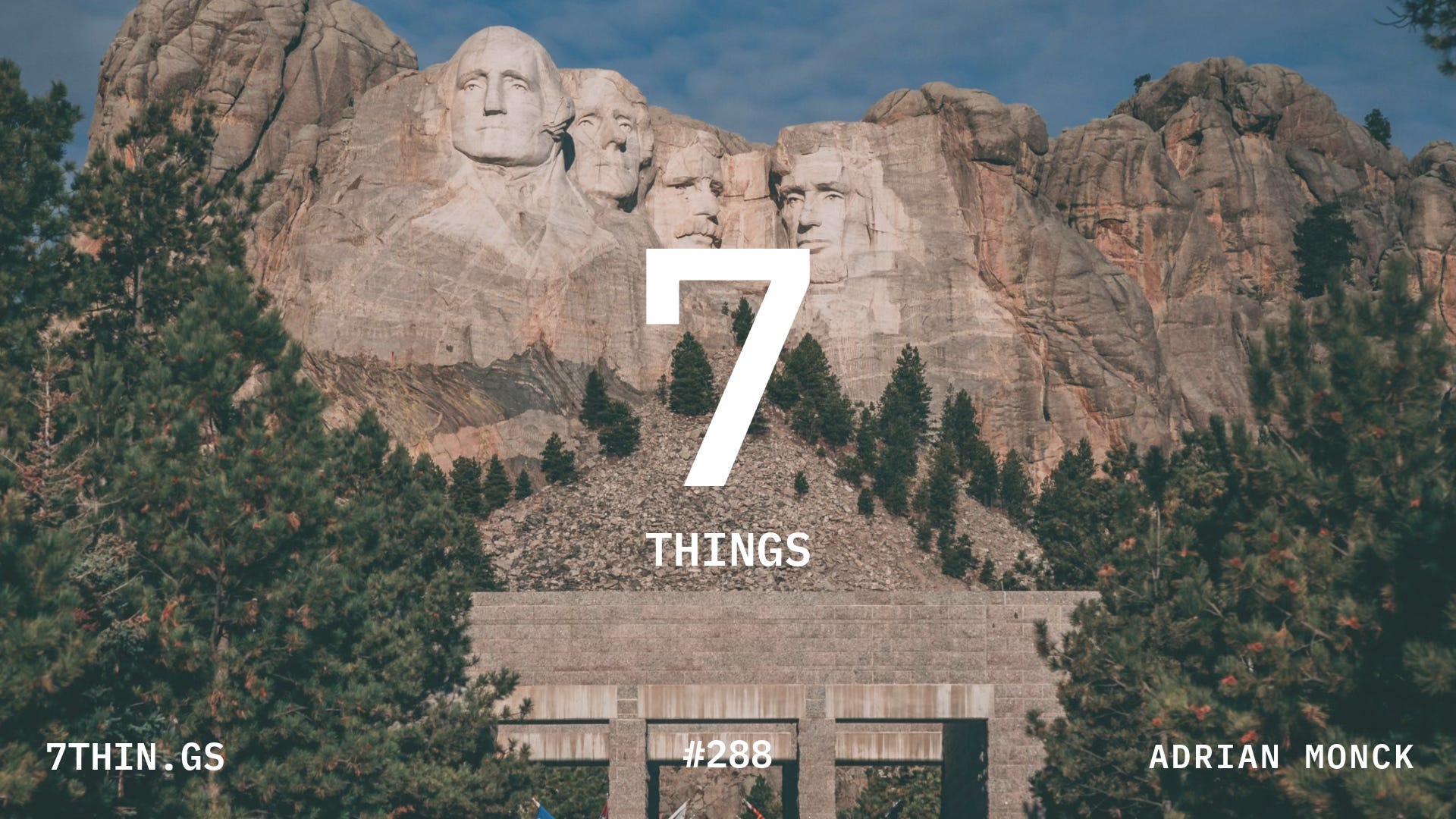
Rushmore Revenge
Why Trump wants Greenland – and what it reveals about his second term
Grüezi!
This week, the mask came off. Trump told the New York Times that owning Greenland is ‘psychologically needed for success.’
Asked whether that meant for America or for him personally?
‘Psychologically important for me.’
Hours before yesterday’s White House meeting with Danish and Greenlandic officials, he declared anything less than US ownership ‘unacceptable’.
The rational-actor frameworks have collapsed.
What remains is simpler and stranger than the analysts imagined.
1. The Rushmore Rationale
In 2018, South Dakota governor Kristi Noem met Trump for the first time. She offered to show him her state’s most famous monument – Mount Rushmore.
‘You know it’s my dream to have my face on Mount Rushmore?’ Trump told her.
She thought he was joking. He wasn’t.
In 2020, she commissioned a bronze replica with his face added beside Lincoln and presented it to him at a July 4th celebration.
Last week, Florida Congresswoman Anna Paulina Luna introduced legislation to carve Trump’s face onto the actual monument. She is also sponsoring a bill to acquire Greenland.
Her reasoning? Washington, Jefferson, Lincoln, and Roosevelt are on Rushmore because they expanded America’s territory. What better way for Trump to earn his place than to add Greenland, Canada, and Panama?
Peter Baker and Susan Glasser’s book on Trump’s first term reported that Greenland had grabbed his attention as ‘essentially, a big real estate deal’ that ‘might give him a place in American history like William Seward’s purchase of Alaska.’
America was already Greenland’s suzerain. Denmark offered everything short of sovereignty: expanded bases, mineral access, joint exercises, billions in Arctic defence.
Trump refused. Because solving the security problem was never the point. The map is.
2. Miller Time
During Trump’s first term, aides humoured him with offers to investigate buying Greenland. They didn’t think he was serious.
Those advisers are gone.
Stephen Miller – now deputy chief of staff for policy and homeland security adviser – meets daily with Trump to review executive orders.
When VP Vance questioned military strikes in Yemen on the administration’s Signal chain, Miller shut him down: ‘As I heard it, the president was clear. Green light.’
Miller’s wife Katie posted an AI-generated map of Greenland overlaid with stars and stripes on 3 January – the day of the Venezuela operation – with the caption: ‘SOON.’
Asked by Jake Tapper about Denmark’s 300-year claim, Miller replied: ‘By what right does Denmark assert control over Greenland?’
The new world? In Miller’s words, one ‘governed by strength, governed by force, governed by power.’
Trump has the ego, but as one former adviser noted: ‘Stephen is the president’s id … It’s just now he has the leverage and power to fully effectuate it.’
3. The Security Irrationale
Trump claims Greenland is ‘covered with Russian and Chinese ships all over the place.’ Rasmussen addressed this directly:
‘The narrative that we have Chinese warships all around the place is not true. According to our intelligence, we have not had Chinese warships in Greenland for a decade or so.’
Norwegian defence analysts had already called Trump’s claim ‘nonsense.’
A heating engineer in Nuuk put it more plainly: ‘The only Chinese I see is when I go to the fast food market.’ He sails and hunts frequently. Never seen a Russian or Chinese ship.
The US already operates Pituffik Space Base under a 1951 agreement that allows expanded military presence without sovereignty transfer. During the Cold War, America stationed 6,000 troops across Greenland, and the current arrangement permits US force surges without Danish approval.
For its part, Denmark has committed over $6 billion to Arctic defence, bought additional F-35s and P-8 Poseidons, and pledged 5% of GDP on defence over the next decade.
As Greenland’s former finance minister Maliina Abelsen observed:
‘It looks like an attempt to plant a flag and expand the US footprint simply to be able to say it was done.’
NBC News reported this week that buying Greenland could cost up to $700 billion – more than half America’s annual defence budget.
A US official familiar with the negotiations offered this assessment: ‘Why invade the cow when they’ll sell you the milk at relatively good prices?’
4. The Wealth of Ice Stations
A ‘closed loop’ of investors, billionaires, and Trump have converged on Greenland anyway. KoBold Metals, which uses AI to locate mineral deposits, has a 51% stake in Greenland’s Disko-Nuussuaq project. Its backers include Jeff Bezos, Mark Zuckerberg, Sam Altman, and Andreessen Horowitz.
Critical Metals Corp – developing the Tanbreez rare earth mine – counts among its investors hedge funds connected to Commerce Secretary Howard Lutnick. Peter Thiel’s Pronomos Capital backs Praxis, a venture aiming to build a ‘crypto-native’ libertarian city in Greenland.
Trump appointed Ken Howery – Peter Thiel’s partner and PayPal co-founder – as ambassador to Denmark. The tech moguls with Greenland mining stakes gave generously to Trump’s campaign. Meta and Amazon each donated to his inauguration.
No one is looking to make billions. But no one is looking to lose money either.
The security catch? Greenland’s rare earth deposits are low-grade, infrastructure minimal, environmental regulations strict – and China controls 90% of global rare earth processing.
Even if you mine it, you still need Beijing to refine it.
Development would take a decade minimum. The economic rationale is as hollow as the security one.
What remains is the map, the monument, and the money flowing to those who enable it.
5. Nuuk-lear Deterrent
On the eve of yesterday’s White House meeting, Greenland’s Prime Minister Jens-Frederik Nielsen declared:
‘If we have to choose between the United States and Denmark here and now, we choose Denmark. We choose NATO. We choose the Kingdom of Denmark. We choose the EU.’
Asked about this, Trump replied: ‘I disagree with him. I don’t know who he is. I don’t know anything about him. But, that’s going to be a big problem for him.’
An overwhelming majority of Greenlanders oppose US incorporation. In Nuuk, the island’s capital, a 22-year-old student told AP she hoped American officials would ‘back off.’
A telecom worker said Greenlanders support eventual independence – but from Denmark to sovereignty, not American rule.
A fisherman was more direct: ‘American, no! We were a colony for so many years. We’re not ready to be a colony again.’
Americans aren’t enthusiastic either. The Reuters/Ipsos poll found just 17% approve of Trump’s acquisition efforts – with 47% opposed. Only 4% support using military force, including just one in ten Republicans.
Two-thirds of Americans – including 40% of Republicans – are concerned the push could harm NATO and damage relations with Europe.
Miller described Greenland as having 30,000 people. The actual population is 57,000. The administration hasn’t read about the country it wants to acquire.
6. The Venezuela Wake Up Call
At the beginning of January, US forces captured Venezuela’s President Maduro in Caracas and flew him to New York for trial. Trump declared America would ‘run the country’ during transition. At least 40 people died in the operation. International law experts were unanimous. It was a clear violation of the UN Charter and Venezuelan sovereignty.
The operation transformed Europe’s perception of Trump’s Greenland rhetoric from bluster to credible threat.
Danish officials were ‘blindsided’ when Trump appointed a special envoy whose stated role is making Greenland ‘part of the US.’
The White House confirms military options remain on the table. Yesterday, Trump demanded NATO ‘lead the way’ for America to acquire Greenland – asking a defensive alliance to facilitate one member seizing another’s territory.
Denmark is no longer waiting. The Danish Armed Forces have deployed ‘capabilities and units’ to Greenland – aircraft, ships, soldiers – in exercises with NATO allies. Swedish officers arrived yesterday for Operation Arctic Endurance. German Bundeswehr personnel are joining today. Norway is contributing two.
A handful of German soldiers and two Norwegians will not deter American power projection.
News of the deployments gave me a grim reminder of the Dutch peace-keeping presence at Srebrenica – a force whose presence created the illusion of protection with no capacity to provide it.
7. The Alliance’s Edge Case
Denmark’s Prime Minister Frederiksen warned that a US attack on Greenland would mean ‘the end of NATO.’
She’s right – not because Europe could put up a fight, but because the premise of collective defence collapses if the leading member treats its allies as prey.
Article 5 requires unanimous North Atlantic Council approval; the US would simply veto any invocation against itself.
Seven European leaders issued a joint statement: ‘Greenland belongs to its people. It is for Denmark and Greenland, and them only, to decide.’ France announced a consulate in Nuuk opening 6 February. But NATO Secretary General Rutte? Silence.
Not everyone in Washington is willing to watch NATO get traded for an iceberg and drilling rights.
Bipartisan US senators introduced legislation barring federal funds for military action against NATO allies.
And this week, a bipartisan congressional delegation led by Senator Chris Coons – including Republican Thom Tillis – visits Copenhagen to show ‘we understand the value of the partnership.’
Meanwhile the European Parliament is weighing whether to freeze its vote on the EU-US trade deal – due on 26 January – until Greenland’s status is resolved. The trade committee took no decision yesterday; they reconvene next week.
The White House will not be holding its breath.
A Europe unable to resist American tariffs and tech lobbying can hardly defend against more forceful intervention.
For a decade, observers assumed Trump could be managed with flattery and distraction.
The second term has dispensed with that illusion.
Trump justifies Greenland by invoking Russian and Chinese threats. Yet he has not confronted Russia or China.
He seized a Venezuelan president with no allies and now threatens a Danish territory with no army.
The ‘Donroe’ doctrine taking shape is simpler than Monroe’s ever was.
It’s easier to bully your friends than confront your adversaries.
Thanks for reading!
Best
Adrian


Well said. But for me, this is the shocking part: "Two-thirds of Americans – including 40% of Republicans – are concerned the push could harm NATO and damage relations with Europe." This still leaves one-third of Americans who are so clueless about the state of the world that they can't see the obvious - that any move against Denmark will mean the permanent fracturing of the West, the end of NATO, and the end of American hegemony.
But maybe that's exactly the point... How many people in Trump's immediate circle have been found to be Russian assets again?
Brilliant breakdown here. The Mount Rushmore angle is what actually makes this click for me, teh way ego-driven territorial expansion gets packaged as security strategy is pretty wild. I've noticed this pattern where symbolic wins (monument placement, map redrawing) seem to matter more than actuaal strategic gains lately. The Srebrenica comparison at the end is chilling though, makes you rethink what 'deterrence' even looks like when the threat comes from inside the alliance.