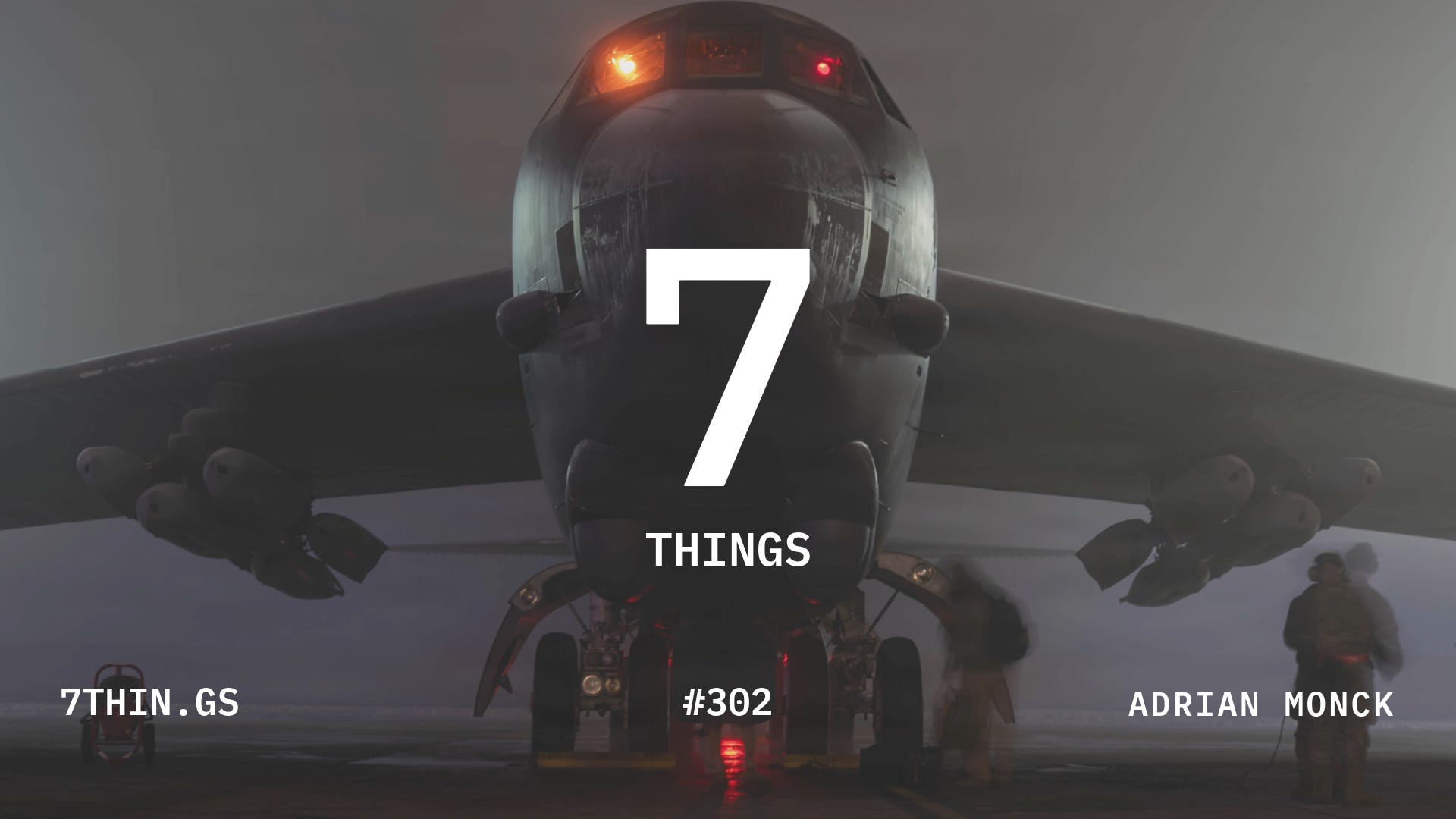
The Trillion-Dollar War Machine: What Is American Armed Power For?
Epic Fury turns America’s military welfare state, industrial policy, and global enforcement mission against itself
Grüezi!
The White House just went to war with Iran whilst proposing the largest military budget in history.
The question of what American military power is actually for has never been more live – or more muddled.
There’s no one answer, because US military spending is three different things – global enforcement, a welfare state in fatigues, and a disguised industrial policy – and their objectives don’t work well together.
Whether or not the war drags on, it has already clarified something that peacetime budget debates usually obscure.
1. The Question Just Became Real
Two weeks ago, the United States and Israel launched joint strikes against Iran, killing Supreme Leader Ali Khamenei and triggering the largest Middle Eastern military operation since the 2003 invasion of Iraq.
Reuters reported severe disruption to tanker movements through the Strait of Hormuz – the chokepoint for roughly a fifth of the world’s oil. Iran retaliated across the region. Oil surged past $100 a barrel.
Days earlier, Trump had posted on Truth Social that 2027’s military budget should be $1.5 trillion – a 50 per cent increase over 2026’s and the biggest proposed rise since the Korean War.
The Committee for a Responsible Federal Budget reckons this would add $5.8 trillion to US national debt over a decade. Trump says tariff revenues will cover it. They won’t – the proposed increase is roughly double the most optimistic projections through 2035.
The justifications for America’s outsized military expenditure – deterrence, trade-route security, dollar hegemony, technology spillovers – are all eminently testable.
Some hold up better than others, and a few are falling apart in front of us.
2. Three Missions, One Military
The US military budget is three programmes jammed into a single institution, and their objectives pull in different directions.
The first is global enforcement: America’s ability to project force, deter foes, and get its own way. This is what most people mean by ‘military power.’
It’s what just went to war with Iran. Its headline cost is the DoD topline – roughly $850 billion in 2025, heading toward $1 trillion when you include reconciliation funds.
The second is a hidden welfare state: healthcare, education, housing, disability compensation, and regional employment routed through the Pentagon and the VA because those are the institutions that America will fund, whilst it will not fund the civilian equivalents.
This is probably the least understood function of the military budget and the one whose downstream liabilities have expanded most rapidly. The Costs of War Project at Brown University estimates $2.2 trillion in future medical bills from post-9/11 wars. And each new conflict adds to that pipeline.
And the third – the one that rarely gets called what it is – is industrial policy: defence R&D at ten times the EU’s Horizon Europe budget, procurement contracts as regional transfers spread across 46 states, strategic technology development, and arms exports as foreign policy.
This is the function that created GPS and helped create the internet. It’s also what concentrated the US defence industry into five firms – which is how the Pentagon ends up paying a million dollars for shoulder-fired missiles designed in the 1970s.
The political durability of the Pentagon budget comes partly from the fact that each of its three functions has a very different constituency, metric, and justification.
Understanding why requires taking each function seriously, and separately.
3. The Warfare Welfare State
A large share of the US military budget is not spent on combat. It is welfare provision with boots on.
The Veterans Health Administration is America’s largest integrated healthcare system – 1,380 facilities, over 371,000 healthcare workers, 9.1 million enrolled veterans, roughly 127 million appointments a year.
The VA cost nearly $370 billion in 2025 and is projected to top $440 billion in 2026. Over 40 per cent of America’s post-9/11 veterans are entitled to lifetime disability payments. That’s expected to rise to 54 per cent over the next three decades.
Those numbers are worth pondering.
For many young Americans from the country’s poorest communities, the military means guaranteed employment, housing, healthcare, education, plus a pension after 20 years.
The GI Bill is the most generous education subsidy available to working-class Americans, conditional on military service. Nearly $100 billion was budgeted for the Post-9/11 GI Bill between 2009 and 2019. Veterans’ college completion rates are double those of comparable civilian students.
The Pentagon pays $29 billion annually in housing allowances. For $55 billion, it runs its own school system, commissary network, and the TRICARE health system.
Enlisted compensation now exceeds the cash pay of 90 per cent of comparable civilians of the same age and education.
No civilian programme comes close.
The CBO’s 2024 Atlas of Military Compensation has the full picture: total military compensation is $600 billion in 2025 – $236 billion from DoD, $365 billion from VA. The VA now accounts for 61 per cent of total military compensation, up from a small fraction as recently as 1999, and up more than fourfold in real terms over 25 years, even as veteran numbers have declined.
A German soldier’s healthcare comes from the statutory insurance system. Their children attend state schools. Public universities charge no tuition. None of those costs appear in Germany’s defence budget.
When they appear in America’s, they also inflate the apparent spending gap between allies – and hide what the money is actually doing.
4. What Military Primacy Buys
America’s warfare welfare state doesn’t take up the whole budget, and the returns to the military’s other functions are not imaginary.
Countries that depend on American military protection tend to hold their reserves in dollars – three-quarters of foreign government holdings of safe US assets are in countries with some military tie to Washington.
That demand is a big part of what keeps the dollar’s reserve-currency status intact, and reserve-currency status is worth a great deal.
The Atlantic Council estimates it lets the US government borrow $7–8 trillion more than it otherwise could.
The technology pipeline is real too: GPS; the internet.
Defence R&D spending runs at almost $150 billion a year. A study found that a 10 per cent increase in government defence R&D generates a 5-6 per cent increase in privately funded R&D. Military spending pulls private investment in behind it, which is why the industrial-policy function is so robust politically.
Arms exports deliver cash and strategic lock-in. The US has 42 per cent of the global arms market, with foreign military sales hitting a record $118 billion in 2024.
Countries purchasing F-35s or Patriot systems sign up for decades of US-controlled software, spare parts, and mission data. That isn’t a side effect – it’s the entire point.
So the returns are real.
The problem is that the institution underpinning all that is also the institution blowing it up – and the Iran war is where that becomes hard to talk around.
5. When the Machine Turns on Itself
The war on Iran is where the three functions collide.
The enforcement function launched an attack during active nuclear negotiations that drove Hormuz tanker traffic close to standstill. Oil surged before swinging wildly on contradictory signals – Trump declaring the war ‘very complete’ while warning of ‘the most intense day of strikes.’ Brent crude spiked within days.
Qatar declared force majeure on its LNG exports after drone attacks. Ras Tanura was shut after a drone strike.
The thing about trade-route security is that it was never premised on the US Navy keeping chokepoints open whilst it was simultaneously attacking the country that straddles the most critical one.
Deterrence failed because it was the United States itself that chose disruption. Global commerce is the collateral damage.
The economic shock this is causing feeds into inflation just when the Fed had been making progress. The IMF rule of thumb is that every 10 per cent rise in oil prices adds 0.4 percentage points to inflation and cuts 0.15 from growth. US gasoline prices jumped 17 per cent in a week.
For developing countries the damage is far worse – Egypt declared a ‘state of near-emergency,’ Djibouti warned of cascading disruption. Dollar hegemony depends in part on the perception that American power is a force for stability.
An attack that shuts down Hormuz, spikes energy prices, and fragments the alliances it was supposed to underwrite does the exact opposite.
And every service member deployed to the Gulf enters a pipeline that terminates, decades from now, in VA hospitals and disability payments.
Since the PACT Act, nearly 800,000 additional veterans have enrolled in VA healthcare.
6. Europe Pays Differently
Meanwhile, the argument in Washington goes, Europe free-rides as America stands guard.
The standard comparison – the US spends 3.5 per cent of GDP on defence whilst Europe spends 2 per cent – doesn’t tell the full story because the two numbers bundle different activity.
Strip out veterans’ care and other non-combat compensation and the gap shrinks considerably.
And Europe does pay. Just not in ways that show up on the NATO balance sheet.
It pays in dependency. Fifty-five per cent of European arms imports come from the US, up from 35 per cent a decade ago. Eight of ten European states choosing new combat aircraft bought American.
Goldman Sachs puts the European defence spending multiplier at just 0.5 – so low because so much of it goes straight to American arms companies. When Europe rearms, a large share of its taxpayers’ money still flows to Lockheed Martin, RTX, and Northrop Grumman. None of that is accidental.
The CFR’s assessment of Europe’s response to the Iran strikes is blunt: the United States launched a major military operation ‘with little to no consultation with its transatlantic allies.’
France authorised American use of its bases while insisting it was not joining the war. The UK permitted the use of Diego Garcia for ‘specific and limited defensive purposes.’ Spain refused and was threatened with economic retaliation.
NATO’s secretary general called the country under attack an ‘exporter of chaos’ whilst acknowledging that NATO was ‘not part of this war’ – a war being prosecuted by its most powerful member.
The ‘free ride’ is actually a system in which Europe subsidises the domestic social commitments that America has militarised.
7. Using is Losing
The United States has spent $8 trillion on its post-9/11 wars. Over $1 trillion of that is interest on borrowing. In 2024, total federal interest payments overtook defence spending for the first time.
The costs of veterans’ care will not peak for decades. And now another war is under way – deficit-financed, like all the others – with downstream obligations that will compound on top of the liabilities already incurred.
But the deeper problem isn’t really about the money, it’s about society.
America routes through its military the public goods – healthcare, education, housing, employment – that it refuses to provide through civilian institutions.
The military budget is partly the price of global primacy and partly the price of that refusal. You can’t honestly assess one without accounting for the other.
The trillion-dollar question was never whether military power pays. It was what using it costs.
It is blocking the trade routes it was supposed to protect. It is fragmenting the alliances it was supposed to sustain.
And as the administration borrows its way forward, underwriting all of it will be someone sitting in a VA waiting room in 2045, from a war that started now.
When it comes to American military might, using is losing.
Thanks for reading,
Best
Adrian


Another brilliant analysis, the kind of which you never see on mainstream media. I feel very lucky to have discovered you!
Hi Mr Adrian, just wanted to say that your analyses are real gems. I've been combing through my most reliable news sources, but it's a lot easier to gets news these days than analyses (even from paid news sites!). Thank you for sharing your insights!