

Who Gets Dollars? End of The Offshored Empire (Part 3)
Washington has started saying out loud who gets dollars and who doesn’t. The world is taking out insurance.

Grüezi!
Who gets dollars? Washington has started answering that question publicly and politically. Europe is building a backstop in euros so it doesn’t have to wait for an answer. The polite fiction that made the post-1989 dollar system globally acceptable is being rudely ripped up.
Part 1 argued that the decades-long American offshore bargain held in part because it was a kind of financial Voldemort, unnameable but ever present. When it did get labelled, it was called globalisation because that sounded rather better than imperial policy.
Part 2 described the substitute that is now being built in industrial terms – compute and consent flowing east, capital and electricity flowing west. This is a substitute that everyone can see.
What wasn’t yet visible was the financial architecture for the substitute. In April 2026, it became a little clearer. What follows is the same process, working its way through monetary policy.
On 18 April, the UAE’s Central Bank chief raised the idea of a US dollar swap line with Treasury Secretary Scott Bessent.
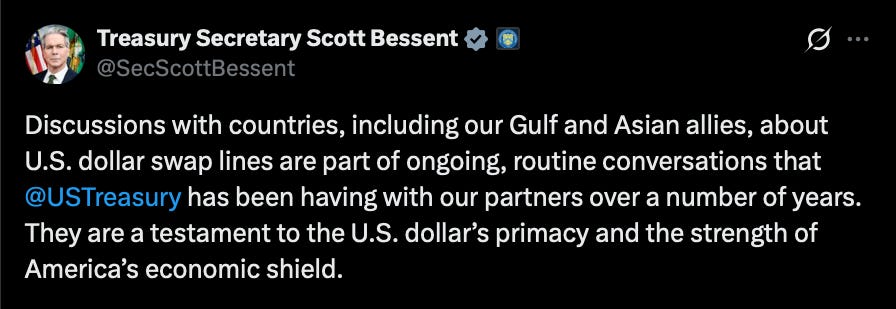
Barely a week later, Bessent posted about “creating new US dollar funding centers in the Gulf and Asia,” and the need to defend against “problematic, alternative payment systems.”
On 28 April, the UAE announced it was leaving OPEC. The following day, Donald Trump’s pick to chair the Fed, wrote that its statutory independence “does not extend to the full range of its congressionally mandated functions” – naming international finance.
In nine days, three signals all pointed the same way. Bessent’s X post. A wealthy Gulf state seemingly aligned. The next Fed chair indicating that some international dollar decisions were a matter for the President.
Those signals are not, on their own, the end of dollar primacy. They may well be a smart consolidation of it.
But once dollar liquidity is discretionary, every state fears what happens if it ends up on the wrong end of that line – and that fear is what the dollar’s old, polite fiction used to calm.
1. Petrodollar Fiction and Fact
The 1974 Kissinger-Faisal arrangement was the petrodollar version of the East Asian template. Gulf producers priced oil in dollars, recycled surpluses into Treasuries, accepted an American security umbrella; the world got a stable reserve currency.
The mechanism was the same one Japan and Korea were running with manufacturing surpluses – sell to America, accumulate dollars, lend them back at low rates – but with oil profits in place of export earnings. As Paul Blustein at CSIS says, the Saudis chose dollars because the depth and liquidity of US markets left them with no alternative. It wasn’t a privilege. The dollar belonged to everyone.
The dollar was not American leverage. It was “plumbing.” Eurodollar markets, IMF stabilisation programmes, the Bretton Woods institutions and the Fed’s role as global lender of last resort all assumed the dollar’s reserve role was a public good that the United States provided and the rest of the world consumed.
In 2008, the Fed responded to the financial crisis by lending dollars to other central banks at a scale never seen before – about $10 trillion across the crisis years, peaking at more than $580 billion at any one moment in late 2008, more than half of it going to the European Central Bank. The lender of last resort doing what lenders of last resort do.
The political point – that the Fed had created dollars and taken on the risk to keep European banks solvent, whilst American homeowners were facing foreclosure – was real, but somehow that never made it into how the system was described. The arrangements were just “plumbing.”
Bessent’s X post of 24 April abandoned that polite fiction. In a single paragraph the Treasury Secretary identifies the petroyuan as the enemy, names the dollar’s reserve status as a contested resource rather than a neutral fact, and signals that in future dollars will go to the grateful not the needy.
None of this is original to Bessent. Back in November 2024, Stephen Miran – then a hedge-fund strategist, now chair of Trump’s Council of Economic Advisers – published A User’s Guide to Restructuring the Global Trading System, which argued for using American security commitments and dollar liquidity as instruments of economic statecraft, and described swap-line access as “a powerful long-term incentive for remaining inside the US security and economic umbrella.”
Bessent just made that policy. And that has big implications.
